Ch.16 - Aqueous Equilibria: Acids & Bases
McMurry - Chemistry 8th Edition
McMurry8th EditionChemistryISBN: 9781292336145당신이 사용하는 게 아니라요?교과서 변경
16장, 문제 147

When NO2 is bubbled into water, it is completely converted to HNO3 and HNO2: 2 NO21g2 + H2O1l2S HNO31aq2 + HNO21aq2 Calculate the pH and the concentrations of all species present (H3O+ , OH-, HNO2, NO2 -, and NO3 -) in a solution prepared by dissolving 0.0500 mol of NO2 in 1.00 L of water. Ka for HNO2 is 4.5 * 10-4.

검증된 단계별 안내
1
Identify the chemical reaction: \(2 \text{NO}_2 (g) + \text{H}_2\text{O} (l) \rightarrow \text{HNO}_3 (aq) + \text{HNO}_2 (aq)\).
Determine the initial concentration of \(\text{NO}_2\) in the solution: Since 0.0500 mol of \(\text{NO}_2\) is dissolved in 1.00 L of water, the initial concentration is 0.0500 M.
Assume complete conversion of \(\text{NO}_2\) to \(\text{HNO}_3\) and \(\text{HNO}_2\), and calculate their initial concentrations: Since the stoichiometry of the reaction is 2:1:1, the initial concentrations of \(\text{HNO}_3\) and \(\text{HNO}_2\) are both 0.0250 M.
Use the given \(K_a\) for \(\text{HNO}_2\) to set up an equilibrium expression: \(K_a = \frac{[\text{H}_3\text{O}^+][\text{NO}_2^-]}{[\text{HNO}_2]}\).
Calculate the pH of the solution: Use the equilibrium concentrations from the \(K_a\) expression to find \([\text{H}_3\text{O}^+]\), and then calculate pH using \(\text{pH} = -\log[\text{H}_3\text{O}^+]\).

비슷한 문제에 대한 검증된 영상 답변:

이 영상 해법은 위 문제에 도움이 된다고 튜터들이 추천한 것입니다.
영상 길이:
10m
도움이 되었나요?

주요 개념

질문에 올바르게 답하기 위해 반드시 이해해야 하는 핵심 개념들은 다음과 같습니다.

Acid-Base Equilibria

Acid-base equilibria involve the dissociation of acids and bases in water, leading to the formation of hydronium ions (H3O+) and hydroxide ions (OH-). In this reaction, NO2 reacts with water to form HNO3 and HNO2, both of which can further dissociate in solution. Understanding the equilibrium expressions and the strength of the acids involved is crucial for calculating pH and concentrations of species in the solution.
추천 영상:
가이드 코스
02:00
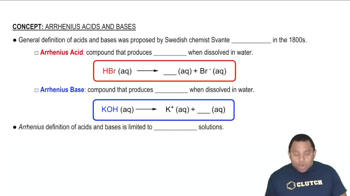
Arrhenius Acids and Bases

Dissociation Constants (Ka and Kb)

Dissociation constants, such as Ka for acids and Kb for bases, quantify the strength of an acid or base in solution. For HNO2, the given Ka value of 4.5 x 10^-4 indicates its tendency to donate protons. This value is essential for calculating the concentrations of HNO2 and its conjugate base NO2- in equilibrium, as well as for determining the pH of the solution.
추천 영상:
가이드 코스
03:01
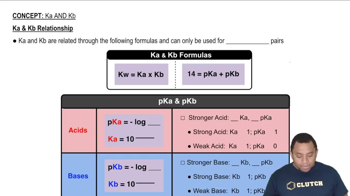
Ka and Kb Relationship

pH Calculation

pH is a measure of the acidity or basicity of a solution, defined as the negative logarithm of the hydronium ion concentration (pH = -log[H3O+]). To calculate the pH in this scenario, one must first determine the concentrations of H3O+ produced from the dissociation of HNO2 and HNO3. The pH can then be derived from these concentrations, providing insight into the solution's overall acidity.
추천 영상:
가이드 코스
02:15
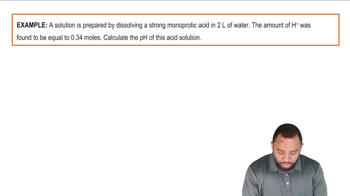
pH Calculation Example