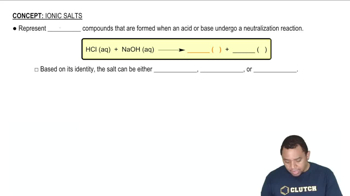
Classify each of the following salt solutions as acidic, basic, or neutral: (a) KBr (b) NaNO2 (c) NH4Br (d) ZnCl2 (e) NH4F
검증된 단계별 안내
1
Step 1: Identify the ions produced by each salt when dissolved in water. For example, KBr dissociates into K⁺ and Br⁻ ions.
Step 2: Determine the nature of each ion. Check if the cation or anion is derived from a strong acid or base. For instance, K⁺ comes from KOH (a strong base) and Br⁻ comes from HBr (a strong acid).
Step 3: Analyze the potential hydrolysis of ions. If an ion can react with water to form H⁺ or OH⁻, it will affect the pH. For example, NO₂⁻ can react with water to form OH⁻, making the solution basic.
Step 4: Consider the effect of both ions in the solution. If both ions are from strong acids and bases, the solution is neutral. If one ion is from a weak acid or base, it will affect the pH.
Step 5: Classify each solution based on the analysis. For example, NH₄⁺ from NH₄Br can donate a proton to water, making the solution acidic.
주요 개념
질문에 올바르게 답하기 위해 반드시 이해해야 하는 핵심 개념들은 다음과 같습니다.
Acid-Base Theory
Acid-base theory explains how substances can donate or accept protons (H+ ions). According to the Brønsted-Lowry theory, acids are proton donors, while bases are proton acceptors. This concept is essential for classifying salt solutions, as the behavior of the ions in solution determines whether the solution is acidic, basic, or neutral.
Salt hydrolysis occurs when an ionic compound dissolves in water and its constituent ions interact with water molecules. This process can lead to the formation of acidic or basic solutions depending on the nature of the ions. For example, cations from weak bases can produce acidic solutions, while anions from weak acids can produce basic solutions.
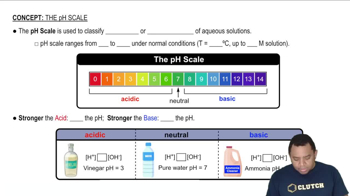
The pH scale measures the acidity or basicity of a solution, ranging from 0 (very acidic) to 14 (very basic), with 7 being neutral. Understanding the pH scale is crucial for classifying salt solutions, as it provides a quantitative measure of the concentration of hydrogen ions in the solution, which directly relates to whether the solution is acidic, basic, or neutral.


 검증된 단계별 안내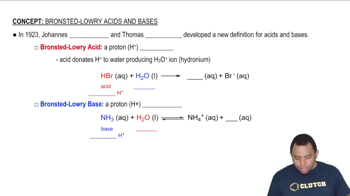
 02:08
02:08