Write a balanced net ionic equation for the principal reaction
in solutions of each of the following salts. In each case,
identify the Brønsted–Lowry acids and bases and the conjugate
acid–base pairs.
(a) Na2CO3
검증된 단계별 안내
1
Identify the ions formed when Na2CO3 (sodium carbonate) dissolves in water. Na2CO3 dissociates into 2 Na+ (sodium ions) and CO3^2- (carbonate ions).
Determine the reaction of the carbonate ion (CO3^2-) with water. CO3^2- acts as a Brønsted–Lowry base because it can accept a proton (H+) from water, forming HCO3^- (bicarbonate ion) and OH^- (hydroxide ion).
Write the net ionic equation for the reaction of CO3^2- with water: CO3^2- (aq) + H2O (l) -> HCO3^- (aq) + OH^- (aq).
Identify the Brønsted–Lowry acid and base in the reaction. The base is CO3^2- as it accepts a proton, and the acid is H2O as it donates a proton.
Identify the conjugate acid-base pairs. The conjugate acid-base pair is CO3^2-/HCO3^- and H2O/OH^-.
비슷한 문제에 대한 검증된 영상 답변:
이 영상 해법은 위 문제에 도움이 된다고 튜터들이 추천한 것입니다.
영상 길이:
3m
영상 재생:
0 댓글
주요 개념
질문에 올바르게 답하기 위해 반드시 이해해야 하는 핵심 개념들은 다음과 같습니다.
Net Ionic Equations
A net ionic equation represents the chemical species that are involved in a reaction, excluding spectator ions. It focuses on the ions and molecules that undergo a change during the reaction, providing a clearer picture of the actual chemical process. To write a net ionic equation, one must first write the complete ionic equation and then remove the ions that do not participate in the reaction.
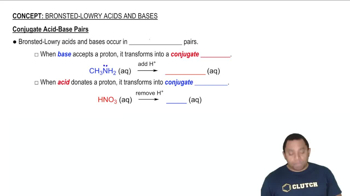
The Brønsted–Lowry theory defines acids as proton donors and bases as proton acceptors. This concept emphasizes the transfer of protons (H⁺ ions) in chemical reactions, allowing for a broader understanding of acid-base behavior beyond just the presence of hydroxide or hydronium ions. Identifying acids and bases in a reaction helps in determining the conjugate acid-base pairs formed during the process.
Conjugate acid-base pairs consist of two species that differ by the presence of a single proton. When an acid donates a proton, it becomes its conjugate base, while the base that accepts the proton becomes its conjugate acid. Understanding these pairs is crucial for analyzing acid-base reactions, as they illustrate the reversible nature of these processes and help predict the direction of equilibrium.


 검증된 단계별 안내
 00:51
00:51