Classify each of the following ions according to whether they
react with water to give a neutral, acidic, or basic solution.
(a) F-
검증된 단계별 안내
1
Step 1: Identify the ion. In this case, the ion is F-, which is the fluoride ion.
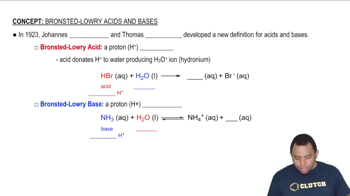
Step 2: Determine if the ion is a conjugate acid or a conjugate base. Since F- is the conjugate base of HF (hydrofluoric acid), it will react with water to form HF and OH-.
Step 3: Understand that the formation of OH- ions will increase the pH of the solution, making it basic.
Step 4: Therefore, F- reacts with water to give a basic solution.
비슷한 문제에 대한 검증된 영상 답변:
이 영상 해법은 위 문제에 도움이 된다고 튜터들이 추천한 것입니다.
영상 길이:
1m
영상 재생:
0 댓글
주요 개념
질문에 올바르게 답하기 위해 반드시 이해해야 하는 핵심 개념들은 다음과 같습니다.
Acid-Base Theory
Acid-base theory explains how substances can donate or accept protons (H+ ions). According to the Brønsted-Lowry theory, acids are proton donors, while bases are proton acceptors. This concept is crucial for understanding how ions interact with water to affect the pH of a solution.
Hydrolysis refers to the reaction of an ion with water, leading to the formation of an acid or base. For example, when fluoride ions (F-) react with water, they can accept a proton, forming HF, which is a weak acid. This process determines whether the resulting solution is acidic, basic, or neutral.
The pH scale measures the acidity or basicity of a solution, with values below 7 indicating acidity, above 7 indicating basicity, and 7 being neutral. Understanding how ions like F- affect the concentration of H+ ions in solution is essential for classifying the resulting solution as acidic, basic, or neutral.


 검증된 단계별 안내
 02:08
02:08