Ch.17 - Applications of Aqueous Equilibria
McMurry - Chemistry 8th Edition
McMurry8th EditionChemistryISBN: 9781292336145당신이 사용하는 게 아니라요?교과서 변경
17장, 문제 151

Consider the reaction that occurs on mixing 50.0 mL of 0.560 M NaHCO3 and 50.0 mL of 0.400 M NaOH at 25 °C. (a) Write a balanced net ionic equation for the reaction. (b) What is the pH of the resulting solution?

검증된 단계별 안내
1
Step 1: Identify the species present in the solution. NaHCO3 dissociates into Na⁺ and HCO₃⁻ ions, while NaOH dissociates into Na⁺ and OH⁻ ions.
Step 2: Write the balanced net ionic equation. The bicarbonate ion (HCO₃⁻) can react with the hydroxide ion (OH⁻) to form carbonate ion (CO₃²⁻) and water (H₂O). The net ionic equation is: HCO₃⁻(aq) + OH⁻(aq) → CO₃²⁻(aq) + H₂O(l).
Step 3: Determine the limiting reactant. Calculate the moles of HCO₃⁻ and OH⁻ using the formula: moles = concentration (M) × volume (L). Compare the moles to find the limiting reactant.
Step 4: Calculate the concentration of the excess reactant after the reaction. Subtract the moles of the limiting reactant from the initial moles of the excess reactant, then divide by the total volume of the solution to find the concentration.
Step 5: Determine the pH of the resulting solution. If OH⁻ is in excess, calculate the pOH from its concentration and then find the pH using the relation: pH + pOH = 14. If CO₃²⁻ is in excess, consider its basic nature and calculate the pH accordingly.

주요 개념

질문에 올바르게 답하기 위해 반드시 이해해야 하는 핵심 개념들은 다음과 같습니다.

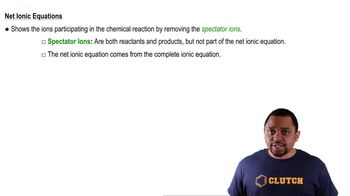
Net Ionic Equations

A net ionic equation represents the chemical species that are involved in a reaction, excluding spectator ions that do not participate. To write a net ionic equation, one must first identify the reactants and products, then eliminate the ions that remain unchanged on both sides of the equation. This focuses on the actual chemical change occurring in the solution.
추천 영상:
가이드 코스
00:51
Net Ionic Equations

Acid-Base Reactions

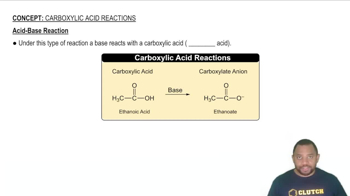
Acid-base reactions involve the transfer of protons (H+) between reactants. In this case, NaHCO3 acts as a weak acid, while NaOH is a strong base. The reaction between them results in the formation of water and a salt, which can affect the pH of the solution. Understanding the nature of these reactants is crucial for predicting the outcome of the reaction.
추천 영상:
가이드 코스
01:09
Acid-Base Reaction

pH Calculation

pH is a measure of the acidity or basicity of a solution, calculated as the negative logarithm of the hydrogen ion concentration. After the reaction, the resulting solution's pH can be determined by considering the concentrations of the remaining acid and base. The final pH will depend on the extent of the reaction and the resulting concentrations of the products.
추천 영상:
가이드 코스
02:15
pH Calculation Example