Ch.17 - Applications of Aqueous Equilibria
McMurry - Chemistry 8th Edition
McMurry8th EditionChemistryISBN: 9781292336145당신이 사용하는 게 아니라요?교과서 변경
17장, 문제 152a

In qualitative analysis, Ca2+ and Ba2+ are seperated from Na+, K+, Mg2+ by adding aqueous (NH4)2CO3 to a solution that also contains aqueous NH3 (Figure 17.18). Assume that the concentrations after mixing are 0.080 M (NH4)2CO3 and 0.16 M NH3. (a) List all the Bronsted-Lowry acids and bases present initially, and identify the principal reaction.

검증된 단계별 안내
1
Step 1: Identify the Bronsted-Lowry acids and bases in the solution. Bronsted-Lowry acids are substances that can donate a proton (H+), and Bronsted-Lowry bases are substances that can accept a proton. In this case, the acids are Ca2+, Ba2+, and (NH4)2CO3, and the bases are Na+, K+, Mg2+, and NH3.
Step 2: Identify the principal reaction. The principal reaction is the reaction that will occur to the greatest extent. In this case, the principal reaction is the reaction between the (NH4)2CO3 and the NH3. This is because (NH4)2CO3 is a weak acid and NH3 is a weak base, and the reaction between a weak acid and a weak base will proceed to a greater extent than the reactions between the other ions present.
Step 3: Write out the principal reaction. The reaction between (NH4)2CO3 and NH3 can be written as follows: (NH4)2CO3 + NH3 -> 2NH4+ + CO3- + NH3. In this reaction, (NH4)2CO3 donates a proton to NH3, forming NH4+ and CO3-.
Step 4: Note that the reaction will shift to the right due to Le Chatelier's principle. This is because the concentration of NH3 is greater than the concentration of (NH4)2CO3, so the reaction will shift to the right to reach equilibrium.
Step 5: Finally, remember that the Ca2+ and Ba2+ ions will not react with the (NH4)2CO3 or the NH3 to any significant extent. This is because these ions are spectator ions in this reaction, meaning they do not participate in the reaction.

비슷한 문제에 대한 검증된 영상 답변:

이 영상 해법은 위 문제에 도움이 된다고 튜터들이 추천한 것입니다.
영상 길이:
3m
도움이 되었나요?

주요 개념

질문에 올바르게 답하기 위해 반드시 이해해야 하는 핵심 개념들은 다음과 같습니다.

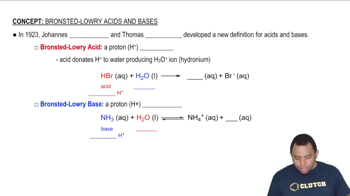
Brønsted-Lowry Theory

The Brønsted-Lowry theory defines acids as proton donors and bases as proton acceptors. This framework helps in understanding acid-base reactions by focusing on the transfer of protons (H+ ions) between species. In the context of the given question, identifying the acids and bases involves recognizing which species can donate or accept protons in the solution.
추천 영상:
가이드 코스
02:08
Bronsted-Lowry Acid-Base Theory

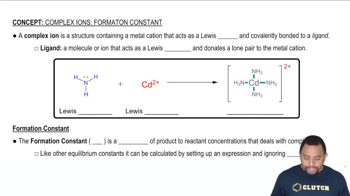
Complex Ion Formation

In qualitative analysis, certain metal ions can form complex ions with ligands, which can affect their solubility and reactivity. For instance, the presence of NH3 can lead to the formation of complex ions with Ca2+ and Ba2+, influencing their separation from other cations. Understanding this concept is crucial for predicting the behavior of ions in the solution when (NH4)2CO3 is added.
추천 영상:
가이드 코스
02:20
Complex Ions and Formation Constant

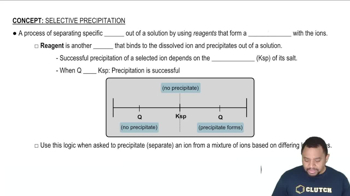
Precipitation Reactions

Precipitation reactions occur when two soluble salts react to form an insoluble compound, or precipitate. In this scenario, the addition of (NH4)2CO3 can lead to the formation of insoluble carbonates of Ca2+ and Ba2+, allowing for their separation from other cations. Recognizing the conditions under which precipitation occurs is essential for analyzing the principal reactions in the solution.
추천 영상:
가이드 코스
01:53
Selective Precipitation