Ch.17 - Applications of Aqueous Equilibria
McMurry - Chemistry 8th Edition
McMurry8th EditionChemistryISBN: 9781292336145당신이 사용하는 게 아니라요?교과서 변경
17장, 문제 86

Consider the titration of 25.0 mL of 0.200 M HCO2H with 0.250 M NaOH. How many milliliters of base are required to reach the equivalence point? Calculate the pH at each of the following points: (c) At the equivalence point, (d) After the addition of 25.0 mL of base.

검증된 단계별 안내
1
Step 1: Determine the moles of formic acid (HCO2H) present initially by using the formula: \( \text{moles} = \text{concentration} \times \text{volume} \).
Step 2: Calculate the volume of NaOH required to reach the equivalence point by using the stoichiometry of the reaction, which is 1:1 for HCO2H and NaOH. Use the formula: \( \text{volume of NaOH} = \frac{\text{moles of HCO2H}}{\text{concentration of NaOH}} \).
Step 3: At the equivalence point, the solution contains the conjugate base (HCO2^-) of formic acid. Calculate the concentration of this conjugate base using the total volume of the solution at the equivalence point.
Step 4: Use the hydrolysis of the conjugate base to find the pH at the equivalence point. Set up the equilibrium expression for the reaction of HCO2^- with water and use the \( K_b \) value, which can be derived from \( K_w / K_a \) of formic acid.
Step 5: For the pH after the addition of 25.0 mL of base, calculate the moles of NaOH added and determine the excess moles of NaOH. Use the concentration of excess OH^- to find the pH.

주요 개념

질문에 올바르게 답하기 위해 반드시 이해해야 하는 핵심 개념들은 다음과 같습니다.

Titration and Equivalence Point

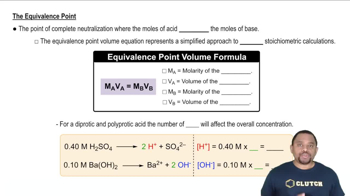
Titration is a quantitative analytical method used to determine the concentration of a solution by reacting it with a solution of known concentration. The equivalence point is reached when the amount of titrant added is stoichiometrically equivalent to the amount of substance in the sample. In this case, it occurs when all the formic acid (HCO2H) has reacted with the sodium hydroxide (NaOH).
추천 영상:
가이드 코스
03:06
Equivalence Point in Titration

Stoichiometry of Acid-Base Reactions

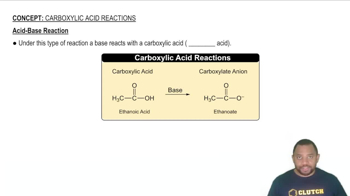
Stoichiometry involves the calculation of reactants and products in chemical reactions. For the titration of HCO2H with NaOH, the balanced equation shows a 1:1 molar ratio, meaning one mole of formic acid reacts with one mole of sodium hydroxide. This relationship is crucial for determining the volume of NaOH needed to reach the equivalence point.
추천 영상:
가이드 코스
01:09
Acid-Base Reaction

pH Calculation at the Equivalence Point

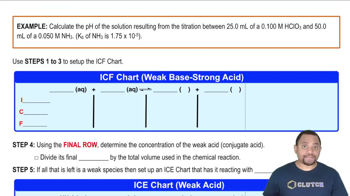
At the equivalence point of a titration involving a weak acid and a strong base, the resulting solution contains the conjugate base of the weak acid. The pH at this point can be calculated using the concentration of the conjugate base and its hydrolysis in water. This involves determining the Kb of the conjugate base and applying the formula for pH based on the concentration of hydroxide ions produced.
추천 영상:
가이드 코스
07:28
pH at the Equivalence Point Example