Ch.17 - Applications of Aqueous Equilibria
McMurry - Chemistry 8th Edition
McMurry8th EditionChemistryISBN: 9781292336145당신이 사용하는 게 아니라요?교과서 변경
17장, 문제 78

Which of the following conjugate acid–base pairs should you choose to prepare a buffer solution that has pH = 4.50? Explain. (a) HSO4- and SO42- (b) HOCl and OCl- (c) C6H5CO2H and C6H5CO2-.

검증된 단계별 안내
1
Step 1: Understand that a buffer solution is most effective when the pH is close to the pKa of the weak acid in the conjugate acid-base pair.
Step 2: Identify the pKa values for each weak acid in the given pairs: (a) HSO4- has a pKa around 1.99, (b) HOCl has a pKa around 7.46, and (c) C6H5CO2H (benzoic acid) has a pKa around 4.20.
Step 3: Compare the pKa values to the desired pH of 4.50. The best buffer system will have a pKa value closest to 4.50.
Step 4: Recognize that the pKa of C6H5CO2H (4.20) is closest to the desired pH of 4.50, making it the most suitable choice for the buffer solution.
Step 5: Conclude that the conjugate acid-base pair C6H5CO2H and C6H5CO2- is the best choice for preparing a buffer solution with a pH of 4.50.

주요 개념

질문에 올바르게 답하기 위해 반드시 이해해야 하는 핵심 개념들은 다음과 같습니다.

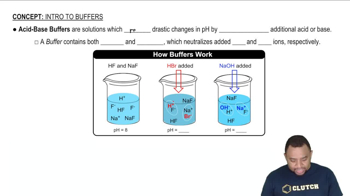
Buffer Solutions

Buffer solutions are mixtures that resist changes in pH when small amounts of acid or base are added. They typically consist of a weak acid and its conjugate base or a weak base and its conjugate acid. The effectiveness of a buffer is determined by the pKa of the weak acid relative to the desired pH, as well as the concentrations of the acid and base components.
추천 영상:
가이드 코스
03:02
Buffer Solutions

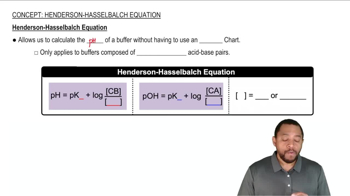
Henderson-Hasselbalch Equation

The Henderson-Hasselbalch equation relates the pH of a buffer solution to the pKa of the weak acid and the ratio of the concentrations of the conjugate base to the weak acid. It is expressed as pH = pKa + log([A-]/[HA]). This equation is crucial for determining the appropriate conjugate acid-base pair to achieve a specific pH in a buffer solution.
추천 영상:
가이드 코스
02:40
Henderson-Hasselbalch Equation

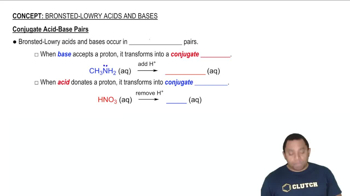
Conjugate Acid-Base Pairs

Conjugate acid-base pairs consist of an acid and its corresponding base, which differ by a proton (H+). For example, in the pair HSO4- (acid) and SO42- (base), HSO4- can donate a proton to form SO42-. The choice of conjugate pairs is essential for buffer preparation, as the pKa of the acid should be close to the desired pH for optimal buffering capacity.
추천 영상:
가이드 코스
01:30
Conjugate Acid-Base Pairs