
Ch.17 - Applications of Aqueous Equilibria
McMurry - Chemistry 8th Edition
McMurry8th EditionChemistryISBN: 9781292336145당신이 사용하는 게 아니라요?교과서 변경
17장, 문제 77

You need a buffer solution that has pH = 7.00. Which of the following buffer systems should you choose? Explain. (a) H3PO4 and H2PO4 - (b) H2PO4- and HPO42- (c) HPO42- and PO43-

검증된 단계별 안내
1
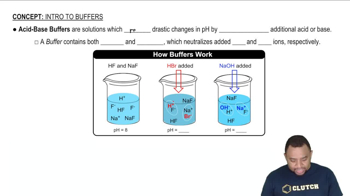
First, understand that a buffer solution is a solution that can resist pH change upon the addition of an acidic or basic components. It is able to neutralize small amounts of added acid or base, thus maintaining the pH of the solution relatively stable. This is achieved by using a weak acid with its conjugate base or a weak base with its conjugate acid.
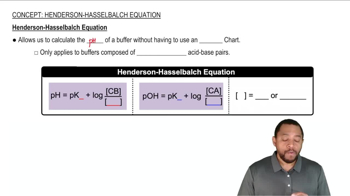
Second, recall that the pH of a buffer solution can be calculated using the Henderson-Hasselbalch equation: pH = pKa + log([A-]/[HA]), where [A-] is the concentration of the base (conjugate) and [HA] is the concentration of the acid.
Third, recognize that the pH of a buffer is most resistant to change when [A-] = [HA]. In this case, the pH of the buffer is equal to the pKa of the acid component.
Fourth, consider the pKa values of the acids in the given buffer systems. The pKa of H3PO4 is 2.15, the pKa of H2PO4- is 7.20, and the pKa of HPO42- is 12.35. The buffer system that will have a pH closest to 7.00 when [A-] = [HA] is the one that uses the acid with a pKa closest to 7.00.
Finally, based on the pKa values, the buffer system that should be chosen is H2PO4- and HPO42-, because the pKa of H2PO4- is closest to 7.00.

비슷한 문제에 대한 검증된 영상 답변:

이 영상 해법은 위 문제에 도움이 된다고 튜터들이 추천한 것입니다.
영상 길이:
3m
도움이 되었나요?

주요 개념

질문에 올바르게 답하기 위해 반드시 이해해야 하는 핵심 개념들은 다음과 같습니다.

Buffer Solutions

A buffer solution is a system that resists changes in pH upon the addition of small amounts of acid or base. It typically consists of a weak acid and its conjugate base or a weak base and its conjugate acid. The ability of a buffer to maintain pH is crucial in many chemical and biological processes.
추천 영상:
가이드 코스
03:02
Buffer Solutions

Henderson-Hasselbalch Equation

The Henderson-Hasselbalch equation relates the pH of a buffer solution to the concentration of its acid and conjugate base. It is expressed as pH = pKa + log([A-]/[HA]), where pKa is the acid dissociation constant. This equation helps determine the appropriate ratio of acid to base needed to achieve a desired pH.
추천 영상:
가이드 코스
02:40
Henderson-Hasselbalch Equation

pKa and pH Relationship

The pKa value of an acid indicates the strength of the acid; lower pKa values correspond to stronger acids. For a buffer to effectively maintain a specific pH, the pKa of the weak acid should be close to the desired pH. In this case, a buffer with a pKa around 7.00 is ideal for achieving a pH of 7.00.
추천 영상:
가이드 코스
02:09
pH and pOH Calculations