Ch.17 - Applications of Aqueous Equilibria
McMurry - Chemistry 8th Edition
McMurry8th EditionChemistryISBN: 9781292336145당신이 사용하는 게 아니라요?교과서 변경
17장, 문제 64

Which of the following gives a buffer solution when equal volumes of the two solutions are mixed? (a) 0.10 M NH3 and 0.10 M HCl (b) 0.20 M NH3 and 0.10 M HCl (c) 0.10 M NH4Cl and 0.10 M NH3 (d) 0.20 M NH4Cl and 0.10 M NaOH

검증된 단계별 안내
1
Step 1: Understand what a buffer solution is. A buffer solution is a solution that can resist changes in pH when small amounts of an acid or a base are added. It is usually made up of a weak acid and its conjugate base, or a weak base and its conjugate acid.
Step 2: Identify the weak base and its conjugate acid in the given options. In this case, NH3 is a weak base and its conjugate acid is NH4+ (which is present in NH4Cl).
Step 3: Look for the option where both the weak base (NH3) and its conjugate acid (NH4+) are present. This is because a buffer solution is formed when a weak base and its conjugate acid (or a weak acid and its conjugate base) are mixed together.
Step 4: From the given options, (c) 0.10 M NH4Cl and 0.10 M NH3 is the pair that forms a buffer solution. This is because NH4Cl is a source of NH4+ (the conjugate acid of NH3) and NH3 is the weak base.
Step 5: Note that the other options do not form a buffer solution because they do not contain both a weak base and its conjugate acid. For example, in option (a), HCl is a strong acid, not a weak one, so it does not form a buffer with NH3. Similarly, in option (d), NaOH is a strong base, not a weak one, so it does not form a buffer with NH4Cl.

비슷한 문제에 대한 검증된 영상 답변:

이 영상 해법은 위 문제에 도움이 된다고 튜터들이 추천한 것입니다.
영상 길이:
3m

주요 개념

질문에 올바르게 답하기 위해 반드시 이해해야 하는 핵심 개념들은 다음과 같습니다.

Buffer Solutions

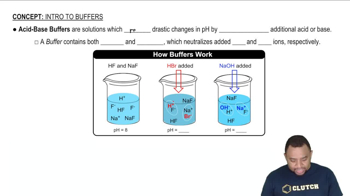
A buffer solution is a system that resists changes in pH upon the addition of small amounts of acid or base. It typically consists of a weak acid and its conjugate base or a weak base and its conjugate acid. This equilibrium allows the buffer to neutralize added acids or bases, maintaining a relatively stable pH.
추천 영상:
가이드 코스
03:02
Buffer Solutions

Weak Acids and Bases

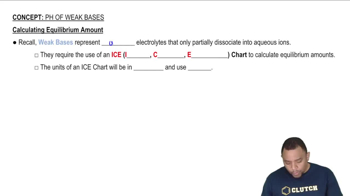
Weak acids and bases are substances that do not completely dissociate in solution. For example, ammonia (NH3) is a weak base that partially reacts with water to form ammonium ions (NH4+) and hydroxide ions (OH-). Understanding the behavior of weak acids and bases is crucial for predicting how they will interact in buffer solutions.
추천 영상:
가이드 코스
00:51
ICE Charts of Weak Bases

Conjugate Acid-Base Pairs

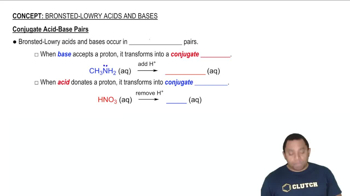
Conjugate acid-base pairs consist of an acid and a base that differ by a single proton (H+). For instance, NH3 (base) and NH4+ (conjugate acid) form a pair. The presence of both components in a solution is essential for creating a buffer, as they can react with added acids or bases to minimize pH changes.
추천 영상:
가이드 코스
01:30
Conjugate Acid-Base Pairs