Ch.17 - Applications of Aqueous Equilibria
McMurry - Chemistry 8th Edition
McMurry8th EditionChemistryISBN: 9781292336145당신이 사용하는 게 아니라요?교과서 변경
17장, 문제 65

Which of the following solutions has the greater buffer capacity: 100 mL of 0.30 M HNO2-0.30 M NaNO2 or 100 mL of 0.10 M HNO2-0.10 M NaNO2? Explain.

검증된 단계별 안내
1
Step 1: Understand the concept of buffer capacity. Buffer capacity refers to the amount of acid or base that can be added to a buffer solution before its pH starts to change significantly. It is directly proportional to the concentrations of the weak acid and its conjugate base (or the weak base and its conjugate acid) in the buffer solution.
Step 2: Identify the components of the buffer solutions. In both solutions, HNO2 is the weak acid and NaNO2 is the salt of its conjugate base, NO2-. The concentrations of HNO2 and NO2- are equal in each solution.
Step 3: Compare the concentrations of the buffer components in the two solutions. The first solution has a concentration of 0.30 M for both HNO2 and NO2-, while the second solution has a concentration of 0.10 M for both.
Step 4: Apply the concept of buffer capacity. Since buffer capacity is directly proportional to the concentrations of the buffer components, the solution with the higher concentrations of HNO2 and NO2- will have the greater buffer capacity.
Step 5: Conclude that the 100 mL of 0.30 M HNO2-0.30 M NaNO2 solution has the greater buffer capacity because it has higher concentrations of the buffer components than the 100 mL of 0.10 M HNO2-0.10 M NaNO2 solution.

비슷한 문제에 대한 검증된 영상 답변:

이 영상 해법은 위 문제에 도움이 된다고 튜터들이 추천한 것입니다.
영상 길이:
2m

주요 개념

질문에 올바르게 답하기 위해 반드시 이해해야 하는 핵심 개념들은 다음과 같습니다.

Buffer Capacity

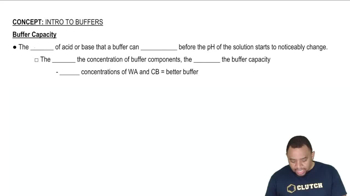
Buffer capacity refers to the ability of a buffer solution to resist changes in pH upon the addition of small amounts of acid or base. It is determined by the concentrations of the weak acid and its conjugate base present in the solution. A higher concentration of these components results in a greater buffer capacity, allowing the solution to maintain a stable pH more effectively.
추천 영상:
가이드 코스
00:45
Buffer Capacity

Henderson-Hasselbalch Equation

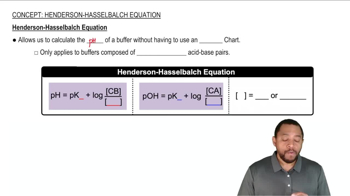
The Henderson-Hasselbalch equation is a mathematical formula used to calculate the pH of a buffer solution. It is expressed as pH = pKa + log([A-]/[HA]), where [A-] is the concentration of the conjugate base and [HA] is the concentration of the weak acid. This equation highlights the relationship between the concentrations of the acid and base in determining the pH and, consequently, the buffer capacity.
추천 영상:
가이드 코스
02:40
Henderson-Hasselbalch Equation

Concentration of Buffer Components

The concentration of buffer components, specifically the weak acid and its conjugate base, directly influences the buffer's effectiveness. In the given question, the first solution has a higher concentration (0.30 M) compared to the second solution (0.10 M). This increased concentration means that the first solution can neutralize more added acid or base, resulting in a greater buffer capacity.
추천 영상:
가이드 코스
00:45
Buffer Capacity