Ch.18 - Thermodynamics: Entropy, Free Energy & Equilibrium
McMurry - Chemistry 8th Edition
McMurry8th EditionChemistryISBN: 9781292336145당신이 사용하는 게 아니라요?교과서 변경
18장, 문제 82

Identify the true statement. A spontaneous reaction must have (a) a negative enthalpy change. (b) a positive enthalpy change. (c) a positive entropy change. (d) a positive free-energy change. (e) a negative free-energy change.

검증된 단계별 안내
1
Step 1: Understand the concept of spontaneity in chemical reactions. A spontaneous reaction is one that occurs naturally under given conditions without needing external energy input.
Step 2: Recall the Gibbs Free Energy equation: \( \Delta G = \Delta H - T \Delta S \), where \( \Delta G \) is the change in free energy, \( \Delta H \) is the change in enthalpy, \( T \) is the temperature in Kelvin, and \( \Delta S \) is the change in entropy.
Step 3: For a reaction to be spontaneous, the change in Gibbs Free Energy (\( \Delta G \)) must be negative. This is the key criterion for spontaneity.
Step 4: Analyze each option: (a) A negative enthalpy change (\( \Delta H < 0 \)) can contribute to spontaneity but is not a requirement. (b) A positive enthalpy change (\( \Delta H > 0 \)) does not necessarily prevent spontaneity if \( T \Delta S \) is large enough. (c) A positive entropy change (\( \Delta S > 0 \)) favors spontaneity but is not a requirement. (d) A positive free-energy change (\( \Delta G > 0 \)) indicates non-spontaneity.
Step 5: Conclude that the correct statement is (e) a negative free-energy change (\( \Delta G < 0 \)) is required for a reaction to be spontaneous.

주요 개념

질문에 올바르게 답하기 위해 반드시 이해해야 하는 핵심 개념들은 다음과 같습니다.

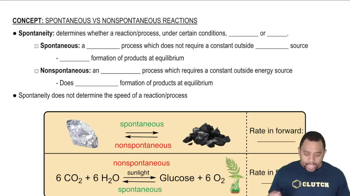
Spontaneity of Reactions

A spontaneous reaction is one that occurs without external intervention. The spontaneity is determined by the change in free energy (ΔG) of the system. If ΔG is negative, the reaction is spontaneous, indicating that the products are more stable than the reactants under the given conditions.
추천 영상:
가이드 코스
04:20
Spontaneity of Processes

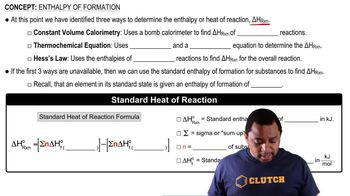
Enthalpy Change (ΔH)

Enthalpy change refers to the heat content of a system at constant pressure. A negative enthalpy change (ΔH < 0) indicates an exothermic reaction, which can favor spontaneity, but it is not a requirement. Spontaneous reactions can also occur with positive enthalpy changes if the entropy change is sufficiently favorable.
추천 영상:
가이드 코스
02:34
Enthalpy of Formation

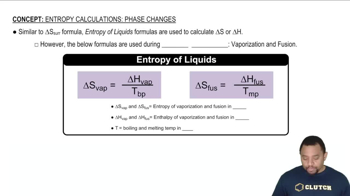
Entropy Change (ΔS)

Entropy is a measure of the disorder or randomness in a system. A positive entropy change (ΔS > 0) indicates an increase in disorder, which can contribute to the spontaneity of a reaction. According to the Gibbs free energy equation (ΔG = ΔH - TΔS), a positive entropy change can help make ΔG negative, thus favoring spontaneity.
추천 영상:
가이드 코스
01:46
Entropy in Phase Changes