
Ch.18 - Thermodynamics: Entropy, Free Energy & Equilibrium
McMurry - Chemistry 8th Edition
McMurry8th EditionChemistryISBN: 9781292336145당신이 사용하는 게 아니라요?교과서 변경
18장, 문제 5

Magnesium m#etal has ΔHfusion = 9.037 kJ>mol and ΔSfusion = 9.79 J>1K mol2. What is the melting point of magnesium in °C? (LO 11.4) (a) 0.923 °C (b) 923 °C (c) 650 °C (d) 1.08 * 103 °C

검증된 단계별 안내
1
Identify the given values: ΔH_fusion = 9.037 kJ/mol and ΔS_fusion = 9.79 J/(K mol).
Convert ΔH_fusion from kJ/mol to J/mol for consistency in units. Recall that 1 kJ = 1000 J.
Use the formula for the melting point (T_m) based on thermodynamics: T_m = ΔH_fusion / ΔS_fusion.
Plug the converted ΔH_fusion and ΔS_fusion values into the formula to calculate T_m in Kelvin.
Convert the temperature from Kelvin to Celsius using the formula: °C = K - 273.15.

비슷한 문제에 대한 검증된 영상 답변:

이 영상 해법은 위 문제에 도움이 된다고 튜터들이 추천한 것입니다.
영상 길이:
6m

주요 개념

질문에 올바르게 답하기 위해 반드시 이해해야 하는 핵심 개념들은 다음과 같습니다.

Gibbs Free Energy

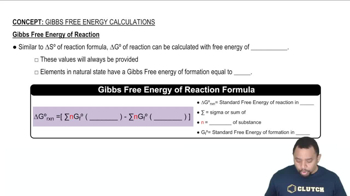
Gibbs Free Energy (G) is a thermodynamic potential that helps predict the direction of chemical reactions and phase changes. It combines enthalpy (ΔH) and entropy (ΔS) into a single value, allowing us to determine if a process is spontaneous at constant temperature and pressure. The relationship is given by the equation ΔG = ΔH - TΔS, where T is the temperature in Kelvin.
추천 영상:
가이드 코스
01:51
Gibbs Free Energy of Reactions

Phase Change and Melting Point

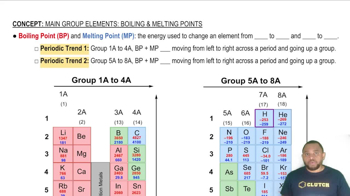
The melting point of a substance is the temperature at which it transitions from solid to liquid. This process involves a change in enthalpy (ΔHfusion) and entropy (ΔSfusion). At the melting point, the Gibbs Free Energy change (ΔG) is zero, indicating that the solid and liquid phases are in equilibrium.
추천 영상:
가이드 코스
04:29
Boiling Point and Melting Point

Calculating Melting Point

To find the melting point of magnesium, we can rearrange the Gibbs Free Energy equation to solve for temperature: T = ΔHfusion / ΔSfusion. By substituting the given values of ΔHfusion and ΔSfusion into this equation, we can calculate the melting point in Kelvin and then convert it to Celsius by subtracting 273.15.
추천 영상:
가이드 코스
04:29
Boiling Point and Melting Point
관련 실천
교과서 질문
Consider the following endothermic reaction of gaseous AB3 molecules with A2 molecules.

Identify the true statement about the spontaneity of the reaction. (a) The reaction is likely to be spontaneous at high temperatures. (b) The reaction is likely to be spontaneous at high temperatures. (c) The reaction is always spontaneous. (d) The reaction is always spontaneous.
558
views
교과서 질문
What is the change in entropy (∆S) when 1.32 g of propane (C3H8) at 0.100 atm pressure is compressed by a factor of five at a constant temperature at 20°C? Assume that propane behaves as an ideal gas. (a) ∆S = +13 J/K (b) ∆S = -13 J/K (c) ∆S = - 0.40 J/K (d) ∆S = + 0.40 J/K
645
views
교과서 질문
Calculate ∆Stotal, and determine whether the reaction is spon-taneous or nonspontaneous under standard-state conditions. (a) -429 J/K; nonspontaneous (b) -123 J/K; spontaneous (c) +3,530 J/K; nonspontaneous (d) +184 J/K; nonspontaneous
397
views
교과서 질문
Identify the true statement about a spontaneous process. (a) A reaction that is nonspontaneous in the forward direction is spontaneous in the reverse direction. (b) Adding a catalyst will cause a nonspontaneous reaction to become spontaneous. (c) In a spontaneous process, the entropy of the system always decreases. (d) An endothermic reaction is always spontaneous.
580
views
교과서 질문
Which of the following reactions has ∆Ssys> 0? (a) N2(g) + 3H2(g) -> 2NH3(g) (b) Ag+(aq) + Cl-(aq) -> AgCl(s) (c) 2H2O2(aq) -> 2H2O(l) + O2(g) (d) 2I(g) -> I2(g)
639
views