
Ch.18 - Thermodynamics: Entropy, Free Energy & Equilibrium
McMurry - Chemistry 8th Edition
McMurry8th EditionChemistryISBN: 9781292336145당신이 사용하는 게 아니라요?교과서 변경
18장, 문제 28

Rank the situations represented by the following drawings according to increasing entropy.

검증된 단계별 안내
1
insert step 1: Understand the concept of entropy. Entropy is a measure of the disorder or randomness in a system. In general, the more disordered a system is, the higher its entropy.
insert step 2: Analyze each drawing. Look for indicators of disorder, such as the number of particles, their arrangement, and their distribution.
insert step 3: Compare the drawings. Identify which drawing has the most ordered arrangement and which has the most disordered arrangement.
insert step 4: Rank the drawings. Start with the drawing that has the least disorder (lowest entropy) and end with the one that has the most disorder (highest entropy).
insert step 5: Review your ranking. Ensure that the order reflects increasing entropy, from the most ordered to the most disordered system.

비슷한 문제에 대한 검증된 영상 답변:

이 영상 해법은 위 문제에 도움이 된다고 튜터들이 추천한 것입니다.
영상 길이:
1m

주요 개념

질문에 올바르게 답하기 위해 반드시 이해해야 하는 핵심 개념들은 다음과 같습니다.

Entropy

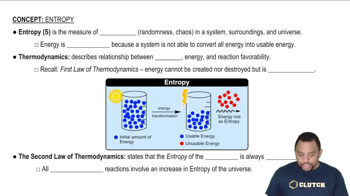
Entropy is a measure of the disorder or randomness in a system. In thermodynamics, it quantifies the number of microscopic configurations that correspond to a thermodynamic system's macroscopic state. Higher entropy indicates greater disorder and a higher number of possible arrangements of particles, while lower entropy suggests a more ordered state.
추천 영상:
가이드 코스
02:46
Entropy in Thermodynamics

States of Matter

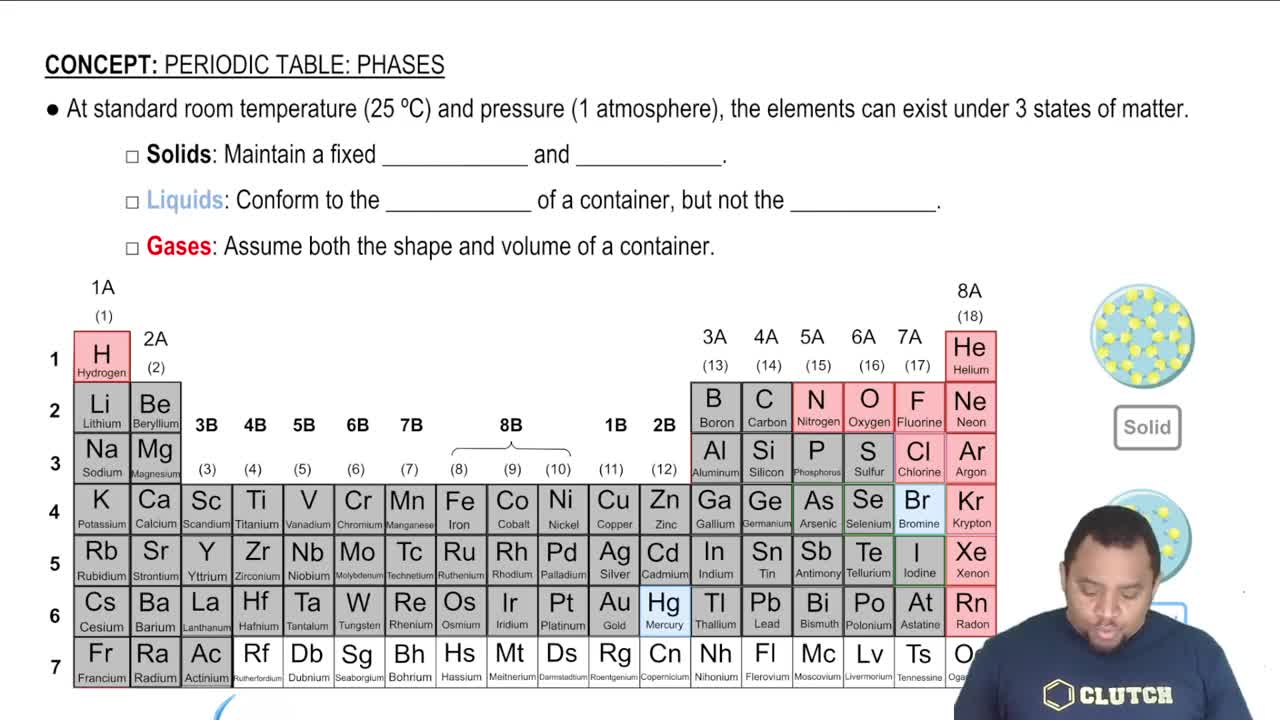
The states of matter—solid, liquid, and gas—differ in their entropy levels. Solids have the lowest entropy due to their fixed, orderly arrangement of particles. Liquids have higher entropy as particles are more mobile, and gases exhibit the highest entropy due to their free movement and vast spacing between particles, allowing for numerous configurations.
추천 영상:
가이드 코스
03:25
Element States of Matter

Thermodynamic Processes

Thermodynamic processes involve changes in energy and matter that can affect a system's entropy. For example, when a solid melts into a liquid or a liquid vaporizes into a gas, the entropy of the system increases. Understanding these processes helps in ranking different situations based on their entropy, as transitions to more disordered states correspond to higher entropy values.
추천 영상:
가이드 코스
01:18
First Law of Thermodynamics
관련 실천
교과서 질문

Consider the dissociation reaction A2(g) ⇌ 2 A(g). The following pictures represent two possible initial states and the equilibrium state of the system:

(b) What are the signs ( + , - , or 0) of ∆H, ∆S, and ∆G when the system goes from initial state 1 to the equilibrium state? Explain. Is this a spontaneous process?

275
views
교과서 질문

Ideal gases A (red spheres) and B (blue spheres) occupy two separate bulbs. The contents of both bulbs constitute the initial state of an isolated system. Consider the process that occurs when the stopcock is opened.

(b) What are the signs ( + , - , or 0) of ∆H, ∆S, and ∆G for this process? Explain.

280
views
교과서 질문

Ideal gases A (red spheres) and B (blue spheres) occupy two separate bulbs. The contents of both bulbs constitute the initial state of an isolated system. Consider the process that occurs when the stopcock is opened.

(c) How dpes this process illustrate the second law of thermodynamics?

326
views
교과서 질문
Consider again the dissociation reaction

(e) What is the value of ∆G for the dissociation reaction when the system is at equilibrium?
312
views
교과서 질문
An ideal gas is compressed at constant temperature. What are the signs ( + , - , or 0) of ∆H, ∆S, and ∆G for the process? Explain.

519
views
교과서 질문

Ideal gases A (red spheres) and B (blue spheres) occupy two separate bulbs. The contents of both bulbs constitute the initial state of an isolated system. Consider the process that occurs when the stopcock is opened.

(d) Relate each of the pictures to the graph in Figure 18.11.

327
views