
Ch.18 - Thermodynamics: Entropy, Free Energy & Equilibrium
McMurry - Chemistry 8th Edition
McMurry8th EditionChemistryISBN: 9781292336145당신이 사용하는 게 아니라요?교과서 변경
18장, 문제 33

Consider again the dissociation reaction Four panels showing the dissociation reaction states leading to equilibrium in chemical thermodynamics.
(e) What is the value of ∆G for the dissociation reaction when the system is at equilibrium?

검증된 단계별 안내
1
Identify the dissociation reaction: X_2 -> 2X.
Recall that at equilibrium, the Gibbs free energy change (∆G) for the reaction is zero.
Understand that ∆G = ∆G° + RT ln(Q), where Q is the reaction quotient.
At equilibrium, Q = K (the equilibrium constant), and thus ∆G = 0.
Therefore, the value of ∆G for the dissociation reaction at equilibrium is zero.

비슷한 문제에 대한 검증된 영상 답변:

이 영상 해법은 위 문제에 도움이 된다고 튜터들이 추천한 것입니다.
영상 길이:
1m

주요 개념

질문에 올바르게 답하기 위해 반드시 이해해야 하는 핵심 개념들은 다음과 같습니다.

Gibbs Free Energy (∆G)

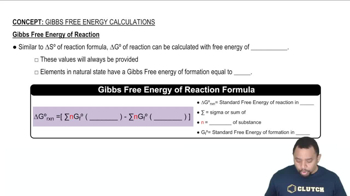
Gibbs Free Energy (∆G) is a thermodynamic potential that measures the maximum reversible work obtainable from a thermodynamic system at constant temperature and pressure. It is a crucial concept in determining the spontaneity of a reaction; if ∆G is negative, the reaction is spontaneous, while a positive ∆G indicates non-spontaneity. At equilibrium, ∆G equals zero, signifying that the forward and reverse reactions occur at the same rate.
추천 영상:
가이드 코스
01:51
Gibbs Free Energy of Reactions

Chemical Equilibrium

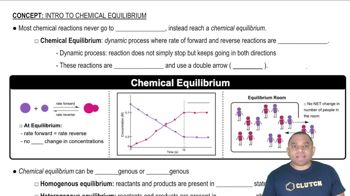
Chemical equilibrium is the state in which the concentrations of reactants and products remain constant over time, as the rates of the forward and reverse reactions are equal. This dynamic balance means that while reactions continue to occur, there is no net change in the concentrations of the substances involved. Understanding equilibrium is essential for predicting how changes in conditions (like concentration or temperature) will affect the system.
추천 영상:
가이드 코스
04:21
Chemical Equilibrium Concepts

Dissociation Reaction

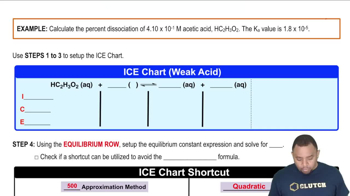
A dissociation reaction involves the breaking apart of a compound into its constituent parts, often resulting in the formation of ions or smaller molecules. In the context of the provided image, the dissociation of X2 into individual X particles illustrates how a substance transitions from a bonded state to a more dispersed state. The extent of dissociation can influence the equilibrium position and the value of ∆G, particularly at different concentrations.
추천 영상:
가이드 코스
04:52
Percent Dissociation Example