
Ch.18 - Thermodynamics: Entropy, Free Energy & Equilibrium
McMurry - Chemistry 8th Edition
McMurry8th EditionChemistryISBN: 9781292336145당신이 사용하는 게 아니라요?교과서 변경
18장, 문제 38

Which of the following processes are spontaneous, and which are nonspontaneous? (a) Freezing of water at 2 °C (b) Corrosion of iron metal (c) Expansion of a gas to fill the available volume (d) Separation of an unsaturated aqueous solution of potassium chloride into solid KCl and liquid water

검증된 단계별 안내
1
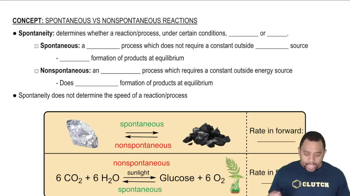
Step 1: Understand the concept of spontaneity. A spontaneous process occurs without external intervention, often driven by a decrease in free energy (ΔG < 0).
Step 2: Analyze process (a). Freezing of water at 2 °C is above the freezing point of water (0 °C), so it is nonspontaneous as it requires energy removal.
Step 3: Analyze process (b). Corrosion of iron is a spontaneous process as it occurs naturally when iron reacts with oxygen and moisture, forming rust.
Step 4: Analyze process (c). Expansion of a gas to fill the available volume is spontaneous because gases naturally spread out to occupy the space available to them.
Step 5: Analyze process (d). Separation of an unsaturated solution into solid KCl and liquid water is nonspontaneous because it requires energy input to overcome the solution's stability.

비슷한 문제에 대한 검증된 영상 답변:

이 영상 해법은 위 문제에 도움이 된다고 튜터들이 추천한 것입니다.
영상 길이:
2m

주요 개념

질문에 올바르게 답하기 위해 반드시 이해해야 하는 핵심 개념들은 다음과 같습니다.

Spontaneity of Processes

A spontaneous process is one that occurs naturally under specific conditions without the need for external energy input. It is often associated with an increase in entropy, or disorder, in the system and its surroundings. The spontaneity of a process can be predicted using thermodynamic principles, particularly the Gibbs free energy change (ΔG), where a negative ΔG indicates a spontaneous reaction.
추천 영상:
가이드 코스
04:20
Spontaneity of Processes

Entropy

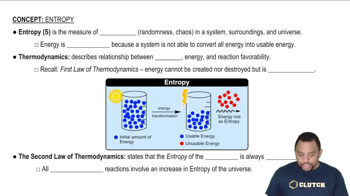
Entropy is a measure of the disorder or randomness in a system. In thermodynamics, it is a key factor in determining the spontaneity of a process. Generally, processes that lead to an increase in the total entropy of the universe (system plus surroundings) are spontaneous. For example, the expansion of a gas increases entropy as the gas molecules spread out into a larger volume.
추천 영상:
가이드 코스
02:46
Entropy in Thermodynamics

Phase Changes and Temperature Effects

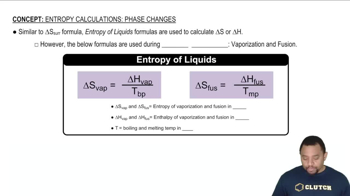
Phase changes, such as freezing or melting, are influenced by temperature and pressure conditions. For instance, water freezes at 0 °C under standard atmospheric pressure, but at 2 °C, the process may not be spontaneous unless the conditions favor it. Understanding the phase diagram of a substance helps predict whether a phase change will occur spontaneously under given conditions.
추천 영상:
가이드 코스
01:46
Entropy in Phase Changes