Ch.19 - Electrochemistry
McMurry - Chemistry 8th Edition
McMurry8th EditionChemistryISBN: 9781292336145당신이 사용하는 게 아니라요?교과서 변경
19장, 문제 93

Given the following half-reactions and E° values, write a balanced equation for the formation of Mn2+ and MnO2 from Mn3+, and calculate the value of E° for this reaction. Is the reaction spontaneous under standard-state conditions?

검증된 단계별 안내
1
Identify the given half-reactions and their standard reduction potentials (E° values).
Write the half-reactions for the reduction and oxidation processes involving Mn species.
Balance the electrons transferred in the half-reactions to ensure the overall charge is balanced.
Combine the balanced half-reactions to form the overall balanced equation for the reaction.
Calculate the standard cell potential (E°) for the reaction by using the formula E° = E°(reduction) - E°(oxidation) and determine if the reaction is spontaneous by checking if E° is positive.

비슷한 문제에 대한 검증된 영상 답변:

이 영상 해법은 위 문제에 도움이 된다고 튜터들이 추천한 것입니다.
영상 길이:
3m
도움이 되었나요?

주요 개념

질문에 올바르게 답하기 위해 반드시 이해해야 하는 핵심 개념들은 다음과 같습니다.

Half-Reactions

Half-reactions represent the oxidation and reduction processes occurring in an electrochemical reaction. Each half-reaction shows the transfer of electrons, with one species being oxidized (losing electrons) and another being reduced (gaining electrons). Understanding how to write and balance these half-reactions is crucial for determining the overall reaction and its electrochemical properties.
추천 영상:
가이드 코스
01:49
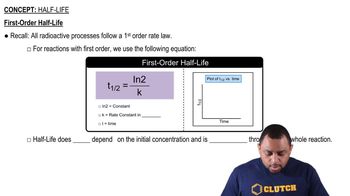
First-Order Half-Life

Standard Electrode Potential (E°)

The standard electrode potential (E°) is a measure of the tendency of a chemical species to be reduced, measured under standard conditions (1 M concentration, 1 atm pressure, and 25°C). It is expressed in volts and is used to predict the direction of electron flow in electrochemical cells. The overall E° for a reaction can be calculated by subtracting the E° of the oxidation half-reaction from that of the reduction half-reaction.
추천 영상:
가이드 코스
01:27
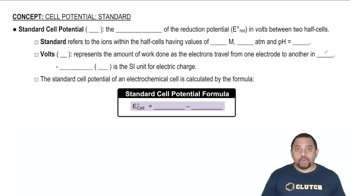
Standard Cell Potential

Spontaneity of Reactions

The spontaneity of a reaction under standard-state conditions can be determined using the Gibbs free energy change (ΔG). A negative ΔG indicates that a reaction is spontaneous, while a positive ΔG suggests it is non-spontaneous. The relationship between E° and ΔG is given by the equation ΔG = -nFE°, where n is the number of moles of electrons transferred and F is Faraday's constant. Thus, a positive E° corresponds to a spontaneous reaction.
추천 영상:
가이드 코스
04:20
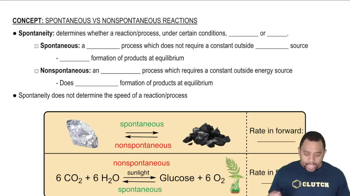
Spontaneity of Processes