Ch.19 - Electrochemistry
McMurry - Chemistry 8th Edition
McMurry8th EditionChemistryISBN: 9781292336145당신이 사용하는 게 아니라요?교과서 변경
19장, 문제 84

The standard potential for the following galvanic cell is 0.40 V: (Europium, Eu, is one of the lanthanide elements.) Use the data in Table 19.1 to calculate the standard reduction potential for Eu3+/Eu2+ half-cell.

검증된 단계별 안내
1
Identify the overall cell reaction and the half-reactions involved in the galvanic cell.
Use the standard cell potential formula: E°_cell = E°_cathode - E°_anode.
Determine which half-reaction corresponds to the cathode and which to the anode using the given standard cell potential.
Look up the standard reduction potential for the other half-cell from Table 19.1.
Rearrange the standard cell potential formula to solve for the unknown standard reduction potential of the Eu3+/Eu2+ half-cell.

비슷한 문제에 대한 검증된 영상 답변:

이 영상 해법은 위 문제에 도움이 된다고 튜터들이 추천한 것입니다.
영상 길이:
3m

주요 개념

질문에 올바르게 답하기 위해 반드시 이해해야 하는 핵심 개념들은 다음과 같습니다.

Galvanic Cells

Galvanic cells, also known as voltaic cells, are electrochemical cells that convert chemical energy into electrical energy through spontaneous redox reactions. In these cells, oxidation occurs at the anode and reduction at the cathode, generating a flow of electrons that can be harnessed for electrical power. The standard cell potential is determined by the difference in standard reduction potentials of the half-reactions involved.
추천 영상:
가이드 코스
01:08
The Galvanic Cell

Standard Reduction Potential

Standard reduction potential (E°) is a measure of the tendency of a chemical species to gain electrons and be reduced, expressed in volts. Each half-reaction has a specific E° value, which is determined under standard conditions (1 M concentration, 1 atm pressure, and 25°C). The more positive the E° value, the greater the species' ability to be reduced, making it a crucial factor in calculating the overall cell potential.
추천 영상:
가이드 코스
01:10
Standard Reduction Potentials

Nernst Equation

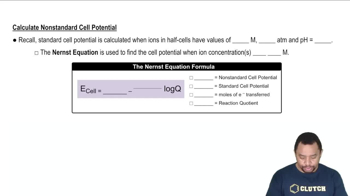
The Nernst equation relates the cell potential to the concentrations of the reactants and products in a redox reaction. It allows for the calculation of the cell potential under non-standard conditions and can be rearranged to find standard potentials when the overall cell potential and one half-cell potential are known. This equation is essential for determining the standard reduction potential of the Eu3+/Eu2+ half-cell in the context of the given galvanic cell.
추천 영상:
가이드 코스
01:17
The Nernst Equation