Ch.19 - Electrochemistry
McMurry - Chemistry 8th Edition
McMurry8th EditionChemistryISBN: 9781292336145당신이 사용하는 게 아니라요?교과서 변경
19장, 문제 151

The sodium–sulfur battery has molybdenum electrodes with anode and cathode compartments separated by b-alumina, a ceramic through which sodium ions can pass. Because the battery operates at temperatures above 300 °C, all the reactants and products are present in a molten solution. The cell voltage is about 2.0 V. (b) How many kilograms of sodium are consumed when a 25 kW sodium–sulfur battery produces current for 32 min?

검증된 단계별 안내
1
Step 1: Calculate the total energy produced by the battery. Use the formula: Energy (in kWh) = Power (in kW) × Time (in hours). Convert 32 minutes into hours.
Step 2: Convert the energy from kWh to joules. Use the conversion factor: 1 kWh = 3.6 × 10^6 J.
Step 3: Calculate the total charge (in coulombs) using the formula: Charge (Q) = Energy (in joules) / Voltage (in volts). Here, the voltage is given as 2.0 V.
Step 4: Use Faraday's laws of electrolysis to find the moles of sodium consumed. The formula is: Moles of Na = Charge (Q) / (n × F), where n is the number of electrons transferred per mole of Na (n = 1 for Na), and F is Faraday's constant (approximately 96485 C/mol).
Step 5: Convert the moles of sodium to mass in kilograms. Use the molar mass of sodium (approximately 22.99 g/mol) and convert grams to kilograms.

비슷한 문제에 대한 검증된 영상 답변:

이 영상 해법은 위 문제에 도움이 된다고 튜터들이 추천한 것입니다.
영상 길이:
5m
도움이 되었나요?

주요 개념

질문에 올바르게 답하기 위해 반드시 이해해야 하는 핵심 개념들은 다음과 같습니다.

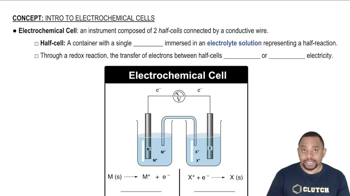
Electrochemical Cells

Electrochemical cells, such as batteries, convert chemical energy into electrical energy through redox reactions. In a sodium-sulfur battery, sodium ions move through a ceramic electrolyte, allowing for the flow of electric current. Understanding the operation of these cells is crucial for calculating the amount of reactants consumed during the battery's operation.
추천 영상:
가이드 코스
02:46
Electrochemical Cells

Current and Charge

Current is the flow of electric charge, measured in amperes (A), and is related to the amount of charge (in coulombs) that passes through a circuit over time. The relationship between current, charge, and time is given by the equation Q = I × t, where Q is charge, I is current, and t is time. This concept is essential for determining how much sodium is consumed based on the current produced by the battery.
추천 영상:

Molar Mass and Stoichiometry

Molar mass is the mass of one mole of a substance, typically expressed in grams per mole. Stoichiometry involves the calculation of reactants and products in chemical reactions based on balanced equations. In this context, knowing the molar mass of sodium allows for the conversion of the total charge produced by the battery into the mass of sodium consumed, facilitating the final calculation.
추천 영상:
가이드 코스
02:11
Molar Mass Concept