
Ch.19 - Electrochemistry
McMurry - Chemistry 8th Edition
McMurry8th EditionChemistryISBN: 9781292336145당신이 사용하는 게 아니라요?교과서 변경
19장, 문제 154

Given the following standard reduction potentials at 25 °C, (a) balance the equation for the reaction of H2MoO4 with elemental arsenic in acidic solution to give Mo3+ and H3AsO4 and (b) calculate E° for this reaction.

검증된 단계별 안내
1
Step 1: Identify the half-reactions involved.
Step 2: Write the reduction half-reaction for H2MoO4 to Mo^{3+}.
Step 3: Write the oxidation half-reaction for elemental arsenic to H3AsO4.
Step 4: Balance each half-reaction for mass and charge.
Step 5: Combine the balanced half-reactions and calculate the standard cell potential, E°.

비슷한 문제에 대한 검증된 영상 답변:

이 영상 해법은 위 문제에 도움이 된다고 튜터들이 추천한 것입니다.
영상 길이:
6m
도움이 되었나요?

주요 개념

질문에 올바르게 답하기 위해 반드시 이해해야 하는 핵심 개념들은 다음과 같습니다.

Standard Reduction Potentials

Standard reduction potentials (E°) are measures of the tendency of a chemical species to gain electrons and be reduced. Each half-reaction has a specific E° value, which is determined under standard conditions (1 M concentration, 1 atm pressure, and 25 °C). These values are crucial for predicting the direction of redox reactions and calculating the overall cell potential.
추천 영상:
가이드 코스
01:10
Standard Reduction Potentials

Balancing Redox Reactions

Balancing redox reactions involves ensuring that both mass and charge are conserved. This typically requires separating the reaction into half-reactions for oxidation and reduction, balancing each for atoms and charges, and then combining them. In acidic solutions, protons (H⁺) and water (H₂O) are often used to achieve balance.
추천 영상:
가이드 코스
01:04
Balancing Basic Redox Reactions

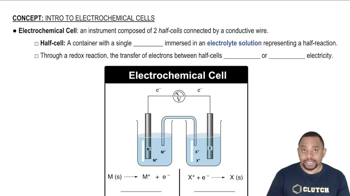
Electrochemical Cell Potential

The electrochemical cell potential (E°cell) is calculated by subtracting the standard reduction potential of the oxidation half-reaction from that of the reduction half-reaction. This value indicates the driving force of the reaction; a positive E°cell suggests that the reaction is spontaneous under standard conditions. Understanding how to calculate E°cell is essential for evaluating the feasibility of redox reactions.
추천 영상:
가이드 코스
02:46
Electrochemical Cells
관련 실천
교과서 질문

The reaction of MnO4 with oxalic acid (H2C2O4) in acidic solution, yielding Mn2+ and CO2 gas, is widely used to determine the concentration of permanganate solutions. (b) Use the data in Appendix D to calculate E° for the reaction. (c) Show that the reaction goes to completion by calculating the values of ∆G° and K at 25 °C. (H2C2O4) in acidic solution, yielding Mn2+ and CO2 gas, is widely used to determine the concentration of permanganate solutions.

1
views
교과서 질문

Chlorine can be prepared in the laboratory by the reaction of hydrochloric acid and potassium permanganate. (a) Use data in Appendix D to write a balanced equation for the reaction. The reduction product is Mn2+.

670
views
교과서 질문

The reaction of MnO4 with oxalic acid (H2C2O4) in acidic solution, yielding Mn2+ and CO2 gas, is widely used to determine the concentration of permanganate solutions. (a) Write a balanced net ionic equation for the reaction.

853
views
교과서 질문
The sodium–sulfur battery has molybdenum electrodes with anode and cathode compartments separated by b-alumina, a ceramic through which sodium ions can pass. Because the battery operates at temperatures above 300 °C, all the reactants and products are present in a molten solution. The cell voltage is about 2.0 V. (b) How many kilograms of sodium are consumed when a 25 kW sodium–sulfur battery produces current for 32 min?
216
views
교과서 질문

The reaction of MnO4 with oxalic acid (H2C2O4) in acidic solution, yielding Mn2+ and CO2 gas, is widely used to determine the concentration of permanganate solutions. (d) A 1.200 g sample of sodium oxalate (Na2C2O4) is dissolved in dilute H2SO4 and then titrated with a KMnO4 solution. If 32.50 mL of the KMnO4 solution is required to reach the equivalence point, what is the molarity of the KMnO4 solution?

1607
views