The following cell reactions occur spontaneously: (a) Arrange the following reduction half-reactions in order of decreasing tendency to occur:
Ch.19 - Electrochemistry
19장, 문제 80a
Use the data in Appendix D to predict whether the following reactions can occur under standard-state conditions. (a) Oxidation of Sn2+(aq) by Br2(aq)
검증된 단계별 안내1
Identify the half-reactions involved in the oxidation of \( \text{Sn}^{2+} \) by \( \text{Br}_2 \).
Write the reduction half-reaction for \( \text{Br}_2 \) and the oxidation half-reaction for \( \text{Sn}^{2+} \).
Use Appendix D to find the standard reduction potentials \( E^0 \) for each half-reaction.
Calculate the standard cell potential \( E^0_{\text{cell}} \) by subtracting the oxidation potential from the reduction potential.
Determine if the reaction is spontaneous under standard conditions by checking if \( E^0_{\text{cell}} > 0 \).

비슷한 문제에 대한 검증된 영상 답변:
이 영상 해법은 위 문제에 도움이 된다고 튜터들이 추천한 것입니다.
영상 길이:
3m도움이 되었나요?
주요 개념
질문에 올바르게 답하기 위해 반드시 이해해야 하는 핵심 개념들은 다음과 같습니다.
Standard-State Conditions
Standard-state conditions refer to a set of specific conditions used to measure the properties of substances. These conditions typically include a temperature of 25°C (298 K), a pressure of 1 atm, and concentrations of 1 M for solutions. Understanding these conditions is crucial for predicting the feasibility of chemical reactions, as they provide a baseline for comparing thermodynamic data.
추천 영상:
가이드 코스
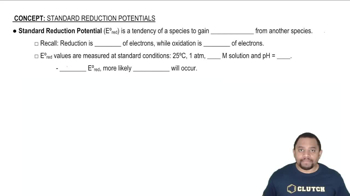
Standard Reduction Potentials
Oxidation-Reduction Reactions
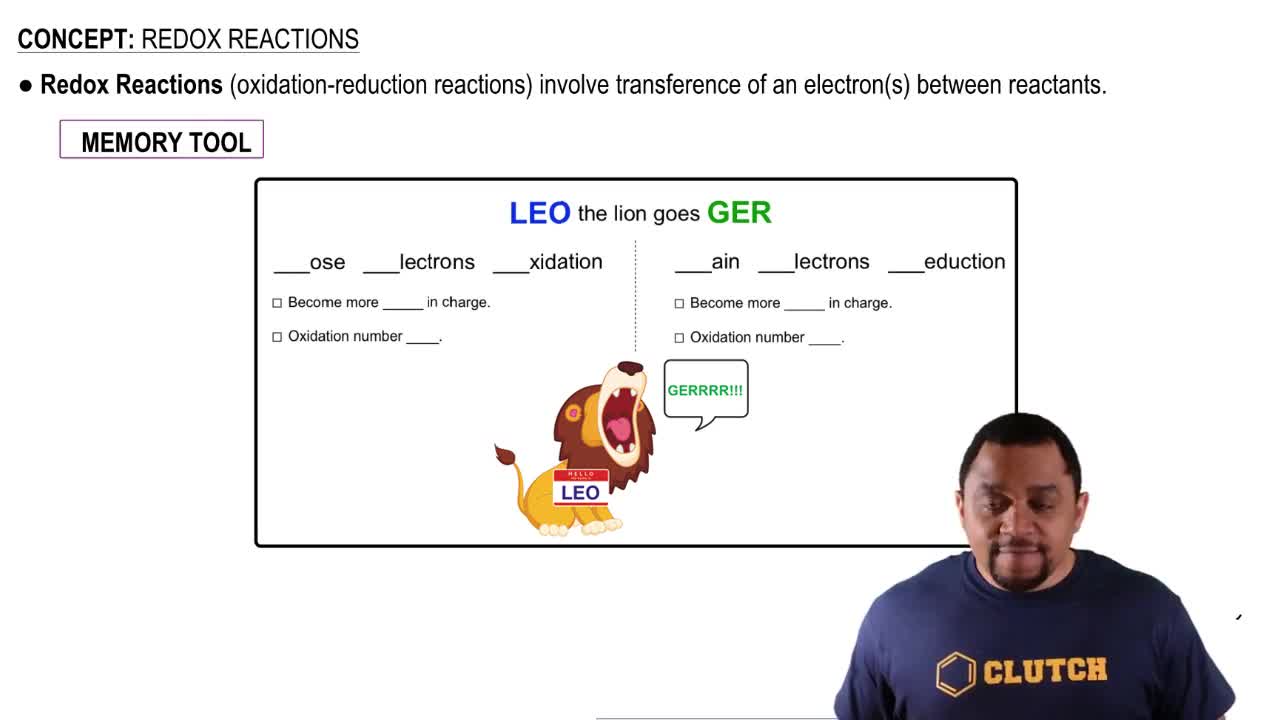
Oxidation-reduction (redox) reactions involve the transfer of electrons between species, resulting in changes in oxidation states. In the given reaction, Sn<sup>2+</sup> is oxidized to Sn<sup>4+</sup>, while Br<sub>2</sub> is reduced to Br<sup>-</sup>. Identifying the oxidizing and reducing agents is essential for predicting whether the reaction can occur spontaneously under standard-state conditions.
추천 영상:
가이드 코스
Oxidation and Reduction Reactions
Electrochemical Cell Potential
The electrochemical cell potential, or standard cell potential (E°), is a measure of the driving force behind a redox reaction. It can be calculated using standard reduction potentials from tables. A positive E° indicates that the reaction is spontaneous under standard-state conditions, while a negative E° suggests it is non-spontaneous. This concept is vital for predicting the feasibility of the oxidation of Sn<sup>2+</sup> by Br<sub>2</sub>.
추천 영상:
가이드 코스
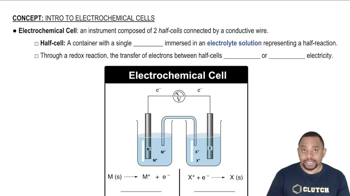
Electrochemical Cells
관련 실천
교과서 질문
370
views
교과서 질문
The following cell reactions occur spontaneously: (b) Which of these substances (A,A+,B,B+,C,C+) is the strongest oxidizing agent? Which is the strongest reducing agent?
573
views
교과서 질문
Use the data in Appendix D to predict whether the following reactions can occur under standard-state conditions. (d) Reduction of I2(s) by H2SO3(aq)
391
views
교과서 질문
The following cell reactions occur spontaneously:
(c) Which of the three cell reactions delivers the highest voltage?
315
views
교과서 질문
Use the data in Appendix D to predict whether the following reactions can occur under standard-state conditions. (b) Reduction of Ni2+(aq) by Sn2+(aq)
299
views
교과서 질문
Use the data in Appendix D to predict whether the following reactions can occur under standard-state conditions. (c) Oxidation of Ag(s) by Pb2+(aq)
341
views