Ch.19 - Electrochemistry
McMurry - Chemistry 8th Edition
McMurry8th EditionChemistryISBN: 9781292336145당신이 사용하는 게 아니라요?교과서 변경
19장, 문제 80b

Use the data in Appendix D to predict whether the following reactions can occur under standard-state conditions. (b) Reduction of Ni2+(aq) by Sn2+(aq)

검증된 단계별 안내
1
Identify the half-reactions involved in the process. For the reduction of Ni^{2+}(aq), the half-reaction is: Ni^{2+}(aq) + 2e^- \(\rightarrow\) Ni(s). For the oxidation of Sn^{2+}(aq), the half-reaction is: Sn^{2+}(aq) \(\rightarrow\) Sn^{4+}(aq) + 2e^-.
Look up the standard reduction potentials (E^\(\circ\)) for each half-reaction in Appendix D. The standard reduction potential for Ni^{2+}(aq) + 2e^- \(\rightarrow\) Ni(s) is E^\(\circ\)_{Ni}. The standard reduction potential for Sn^{4+}(aq) + 2e^- \(\rightarrow\) Sn^{2+}(aq) is E^\(\circ\)_{Sn}.
Calculate the standard cell potential (E^\(\circ\)_{cell}) for the overall reaction. Use the formula: E^\(\circ\)_{cell} = E^\(\circ\)_{cathode} - E^\(\circ\)_{anode}. Here, the cathode is the reduction of Ni^{2+} and the anode is the oxidation of Sn^{2+}.
Determine the spontaneity of the reaction. If E^\(\circ\)_{cell} > 0, the reaction is spontaneous under standard-state conditions. If E^\(\circ\)_{cell} < 0, the reaction is non-spontaneous.
Conclude whether the reduction of Ni^{2+}(aq) by Sn^{2+}(aq) can occur under standard-state conditions based on the calculated E^\(\circ\)_{cell}.

비슷한 문제에 대한 검증된 영상 답변:

이 영상 해법은 위 문제에 도움이 된다고 튜터들이 추천한 것입니다.
영상 길이:
4m
도움이 되었나요?

주요 개념

질문에 올바르게 답하기 위해 반드시 이해해야 하는 핵심 개념들은 다음과 같습니다.

Standard-State Conditions

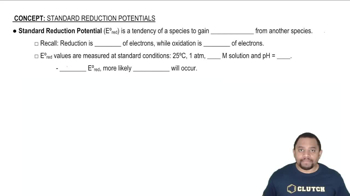
Standard-state conditions refer to a set of specific conditions used to measure and compare the properties of substances. These conditions typically include a temperature of 25°C (298 K), a pressure of 1 atm, and concentrations of 1 M for solutions. Understanding these conditions is crucial for predicting the feasibility of chemical reactions, as they provide a consistent baseline for thermodynamic calculations.
추천 영상:
가이드 코스
01:10
Standard Reduction Potentials

Reduction and Oxidation Reactions

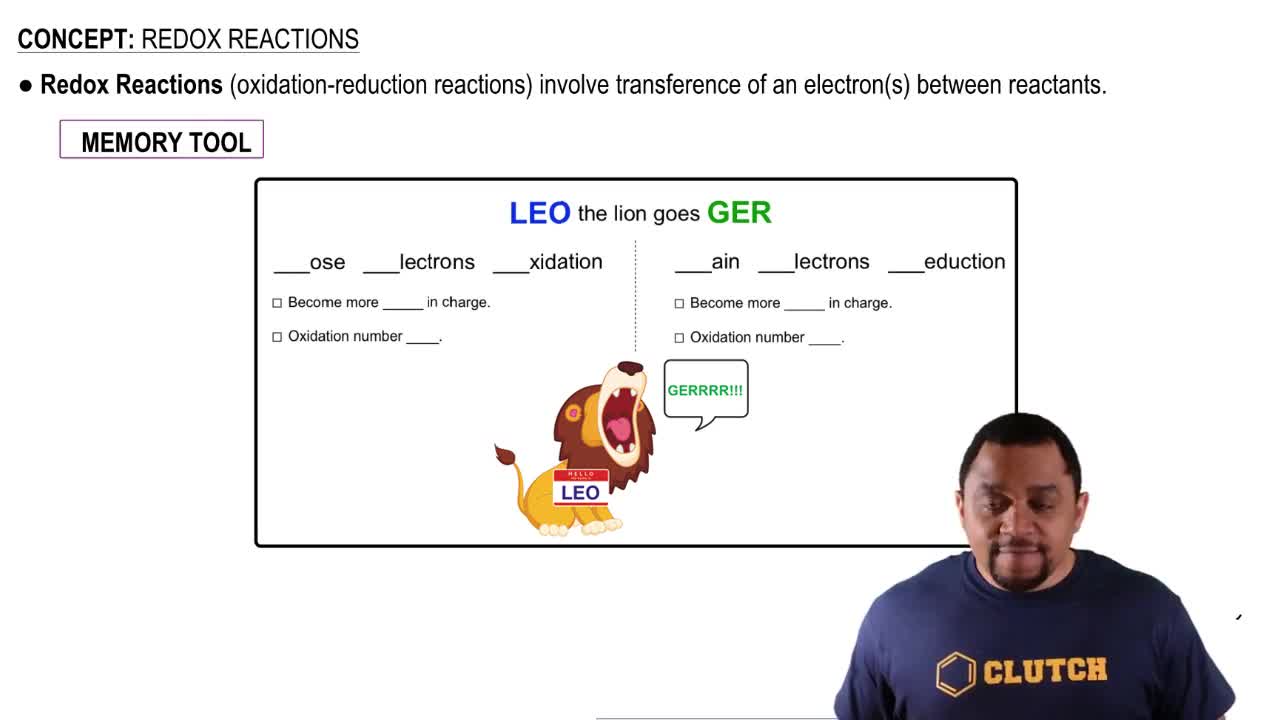
Reduction and oxidation (redox) reactions involve the transfer of electrons between species. In a reduction reaction, a species gains electrons, resulting in a decrease in oxidation state, while oxidation involves the loss of electrons and an increase in oxidation state. Identifying which species is being reduced and which is being oxidized is essential for predicting the direction and spontaneity of the reaction.
추천 영상:
가이드 코스
01:53
Oxidation and Reduction Reactions

Electrochemical Series

The electrochemical series is a list of standard electrode potentials for various half-reactions, arranged by their ability to be reduced. It helps predict the feasibility of redox reactions by comparing the reduction potentials of the reactants. A reaction is likely to occur spontaneously if the reduction potential of the oxidizing agent is higher than that of the reducing agent, indicating a favorable electron transfer.
추천 영상:
가이드 코스
02:46
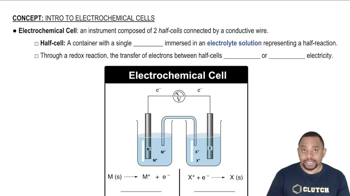
Electrochemical Cells