Ch.19 - Electrochemistry
McMurry - Chemistry 8th Edition
McMurry8th EditionChemistryISBN: 9781292336145당신이 사용하는 게 아니라요?교과서 변경
19장, 문제 83c

What reaction can occur, if any, when the following experiments are carried out under standard-state conditions? (c) A silver wire is immersed in an aqueous solution of NiCl2.

검증된 단계별 안내
1
Identify the possible redox reaction: Silver (Ag) and Nickel (Ni) can potentially undergo a redox reaction. Silver can be reduced, and nickel can be oxidized.
Write the half-reactions: The reduction half-reaction for silver is Ag^+ + e^- → Ag, and the oxidation half-reaction for nickel is Ni → Ni^2+ + 2e^-.
Determine the standard electrode potentials: Look up the standard reduction potentials for Ag^+ to Ag and Ni^2+ to Ni. Ag^+ + e^- → Ag has a potential of +0.80 V, and Ni^2+ + 2e^- → Ni has a potential of -0.25 V.
Calculate the cell potential: Use the formula E°_cell = E°_cathode - E°_anode. Substitute the values to find the overall cell potential.
Analyze the feasibility: If the calculated E°_cell is positive, the reaction is spontaneous under standard conditions. If negative, no reaction occurs.

비슷한 문제에 대한 검증된 영상 답변:

이 영상 해법은 위 문제에 도움이 된다고 튜터들이 추천한 것입니다.
영상 길이:
1m

주요 개념

질문에 올바르게 답하기 위해 반드시 이해해야 하는 핵심 개념들은 다음과 같습니다.

Standard-State Conditions

Standard-state conditions refer to a set of specific conditions used to measure the properties of substances. These typically include a temperature of 25°C (298 K), a pressure of 1 atm, and concentrations of 1 M for solutions. Understanding these conditions is crucial for predicting the behavior of chemical reactions and the feasibility of reactions under specified circumstances.
추천 영상:
가이드 코스
01:10
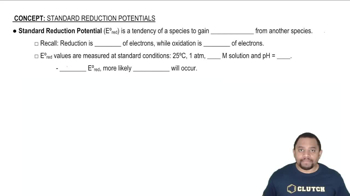
Standard Reduction Potentials

Electrochemical Reactions

Electrochemical reactions involve the transfer of electrons between species, often occurring in redox (reduction-oxidation) processes. In the context of the silver wire and NiCl2 solution, it is important to consider the standard reduction potentials of silver and nickel ions to determine if a spontaneous reaction can occur. The relative positions of these potentials dictate whether one metal can displace another from its ionic form.
추천 영상:
가이드 코스
02:46
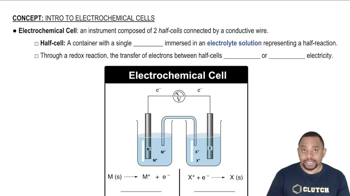
Electrochemical Cells

Displacement Reactions

Displacement reactions occur when a more reactive element displaces a less reactive element from its compound. In this scenario, if silver (Ag) is more reactive than nickel (Ni) in the context of their respective ions, a reaction will take place where silver ions are produced, and nickel is deposited. Understanding the reactivity series of metals is essential for predicting the outcome of such reactions.
추천 영상:
가이드 코스
01:11
Single Displacement Reactions