
Ch.2 - Atoms, Molecules & Ions
McMurry - Chemistry 8th Edition
McMurry8th EditionChemistryISBN: 9781292336145당신이 사용하는 게 아니라요?교과서 변경
2장, 문제 166

Ammonia (NH3) and hydrazine (N2H4) are both compounds of nitrogen and hydrogen. Based on the law of multiple pro-portions, how many grams of hydrogen would you expect 2.34 g of nitrogen to combine with to yield ammonia? To yield hydrazine?

검증된 단계별 안내
1
Understand the law of multiple proportions, which states that if two elements form more than one compound, the masses of one element that combine with a fixed mass of the other are in the ratio of small whole numbers.
Determine the molar masses of nitrogen (N) and hydrogen (H). Nitrogen has a molar mass of approximately 14.01 g/mol, and hydrogen has a molar mass of approximately 1.01 g/mol.
Calculate the mass ratio of hydrogen to nitrogen in ammonia (NH_3). In NH_3, there is 1 nitrogen atom and 3 hydrogen atoms. The molar mass of NH_3 is 14.01 g/mol (N) + 3 * 1.01 g/mol (H) = 17.04 g/mol. The mass ratio of hydrogen to nitrogen is (3 * 1.01) / 14.01.
Calculate the mass ratio of hydrogen to nitrogen in hydrazine (N_2H_4). In N_2H_4, there are 2 nitrogen atoms and 4 hydrogen atoms. The molar mass of N_2H_4 is 2 * 14.01 g/mol (N) + 4 * 1.01 g/mol (H) = 32.06 g/mol. The mass ratio of hydrogen to nitrogen is (4 * 1.01) / (2 * 14.01).
Use the mass ratios to determine how many grams of hydrogen would combine with 2.34 g of nitrogen for each compound. Multiply the mass of nitrogen (2.34 g) by the respective mass ratio of hydrogen to nitrogen for NH_3 and N_2H_4.

비슷한 문제에 대한 검증된 영상 답변:

이 영상 해법은 위 문제에 도움이 된다고 튜터들이 추천한 것입니다.
영상 길이:
2m
도움이 되었나요?

주요 개념

질문에 올바르게 답하기 위해 반드시 이해해야 하는 핵심 개념들은 다음과 같습니다.

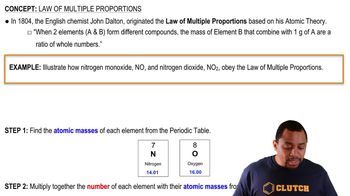
Law of Multiple Proportions

The Law of Multiple Proportions states that when two elements form more than one compound, the ratios of the masses of one element that combine with a fixed mass of the other element can be expressed as small whole numbers. This principle allows us to understand how different compounds can be formed from the same elements in varying proportions.
추천 영상:
가이드 코스
03:32
Law of Multiple Proportions

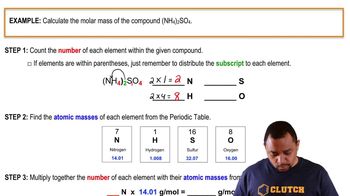
Molar Mass Calculation

Molar mass is the mass of one mole of a substance, typically expressed in grams per mole (g/mol). For ammonia (NH3), the molar mass is approximately 17 g/mol, while for hydrazine (N2H4), it is about 32 g/mol. Knowing the molar masses is essential for converting between grams and moles, which is necessary for applying the law of multiple proportions.
추천 영상:
가이드 코스
03:12
Molar Mass Calculation Example

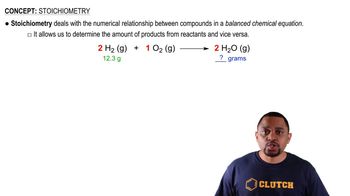
Stoichiometry

Stoichiometry is the area of chemistry that involves the calculation of reactants and products in chemical reactions. It uses the coefficients from balanced chemical equations to determine the relationships between the amounts of substances involved. In this case, stoichiometry will help calculate how much hydrogen combines with a given mass of nitrogen to form ammonia and hydrazine.
추천 영상:
가이드 코스
01:16
Stoichiometry Concept