(b) Without looking at a periodic table, list as many alkaline earth metals as you can. (There are five common ones.)
검증된 단계별 안내
1
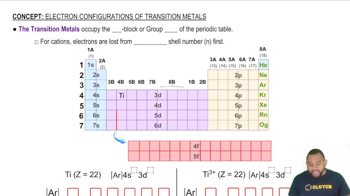
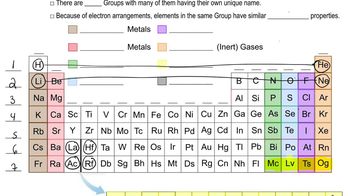
Recall that alkaline earth metals are located in Group 2 of the periodic table.
Remember that these metals are characterized by having two electrons in their outermost shell, which they tend to lose to form divalent cations.
Identify the first member of the group, which is directly below hydrogen in the periodic table.
Continue listing the elements down the group, noting that each successive element has an atomic number that is higher by 4 compared to the previous one in the group.
List the common alkaline earth metals up to the fifth member of the group.
비슷한 문제에 대한 검증된 영상 답변:
이 영상 해법은 위 문제에 도움이 된다고 튜터들이 추천한 것입니다.
영상 길이:
1m
영상 재생:
0 댓글
도움이 되었나요?
주요 개념
질문에 올바르게 답하기 위해 반드시 이해해야 하는 핵심 개념들은 다음과 같습니다.
Alkaline Earth Metals
Alkaline earth metals are a group of elements found in Group 2 of the periodic table. They are characterized by having two electrons in their outermost shell, which makes them highly reactive, though less so than alkali metals. The five common alkaline earth metals include beryllium, magnesium, calcium, strontium, and barium. These metals typically form +2 cations and are known for their metallic properties.
The periodic table is organized into columns called groups, which contain elements with similar chemical properties. Group 2, known as the alkaline earth metals, includes elements that share common characteristics such as reactivity and the formation of basic oxides. Understanding the organization of the periodic table helps in predicting the behavior of elements and their compounds based on their group affiliations.
The reactivity of metals refers to how readily they undergo chemical reactions, often by losing electrons to form positive ions. Alkaline earth metals are more reactive than transition metals but less reactive than alkali metals. Their reactivity increases down the group, meaning that heavier alkaline earth metals like barium are more reactive than lighter ones like beryllium. This property is crucial for understanding their applications and behavior in chemical reactions.