

Ch.2 - Atoms, Molecules & Ions
McMurry - Chemistry 8th Edition
McMurry8th EditionChemistryISBN: 9781292336145당신이 사용하는 게 아니라요?교과서 변경
2장, 문제 88b

Label the following statements about J. J. Thomson's cathode-ray tube experiments shown in Figure 2.6 as true or false. (b) A cathode ray is a stream of charged particles.

검증된 단계별 안내
1
Step 1: Understand the context of J.J. Thomson's cathode-ray tube experiments. In these experiments, J.J. Thomson discovered the electron by studying cathode rays. He found that these rays were made up of negatively charged particles, which he called 'corpuscles', but are now known as electrons.
Step 2: Analyze the statement 'A cathode ray is a stream of charged particles.' This statement is referring to the nature of the cathode rays that Thomson was studying.
Step 3: Recall that a cathode ray is indeed a stream of charged particles. These particles are electrons, which carry a negative charge.
Step 4: Therefore, the statement 'A cathode ray is a stream of charged particles' is true in the context of J.J. Thomson's cathode-ray tube experiments.
Step 5: Label the statement as true.

비슷한 문제에 대한 검증된 영상 답변:

이 영상 해법은 위 문제에 도움이 된다고 튜터들이 추천한 것입니다.
영상 길이:
56s
도움이 되었나요?

주요 개념

질문에 올바르게 답하기 위해 반드시 이해해야 하는 핵심 개념들은 다음과 같습니다.

Cathode Rays

Cathode rays are streams of electrons emitted from the cathode in a vacuum tube. They are produced when high voltage is applied across electrodes, causing electrons to be ejected from the cathode and travel towards the anode. This phenomenon was crucial in the discovery of the electron and demonstrated that cathode rays are negatively charged particles.
추천 영상:
가이드 코스
01:35
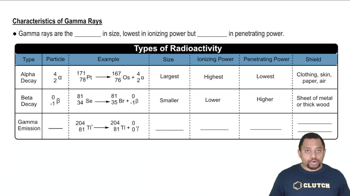
Characteristics of Gamma Rays

Charge of Particles

In Thomson's experiments, it was established that cathode rays are composed of negatively charged particles, later identified as electrons. The charge of these particles was determined through their deflection in electric and magnetic fields, which showed that they are attracted to positive charges and repelled by negative charges, confirming their negative charge.
추천 영상:
가이드 코스
05:19
Subatomic Particles

Thomson's Experiment Significance

J. J. Thomson's cathode-ray tube experiments were pivotal in the field of atomic physics as they provided the first evidence of subatomic particles. His work led to the realization that atoms are not indivisible, as previously thought, but consist of smaller components, fundamentally changing the understanding of atomic structure and leading to the development of the 'plum pudding' model of the atom.
추천 영상:
가이드 코스
02:37
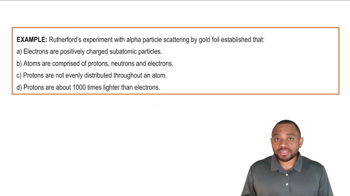
Rutherford Experiment Example