Ch.2 - Atoms, Molecules & Ions
McMurry - Chemistry 8th Edition
McMurry8th EditionChemistryISBN: 9781292336145당신이 사용하는 게 아니라요?교과서 변경
2장, 문제 98

The subscript giving the atomic number of an atom is often left off when writing an isotope symbol. For example, 6 often written simply as 13C. Why is this allowed?

검증된 단계별 안내
1
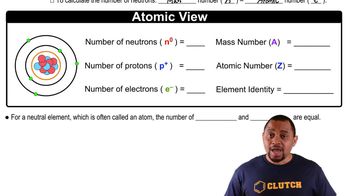
Understand that the atomic number (subscript) represents the number of protons in an atom, which determines the element's identity.
Recognize that each element on the periodic table has a unique atomic number, making it redundant to specify the atomic number when the element symbol is already given.
Realize that isotopes of an element differ in the number of neutrons, not protons. Therefore, the atomic number (indicating protons) remains constant across isotopes of the same element.
Note that the mass number (superscript), which is the sum of protons and neutrons, is more relevant when discussing isotopes. This number changes among isotopes and provides more specific information about the variant of the element.
Conclude that omitting the atomic number when writing an isotope symbol does not lead to ambiguity, as the element symbol sufficiently indicates the atomic number.

비슷한 문제에 대한 검증된 영상 답변:

이 영상 해법은 위 문제에 도움이 된다고 튜터들이 추천한 것입니다.
영상 길이:
57s
도움이 되었나요?

주요 개념

질문에 올바르게 답하기 위해 반드시 이해해야 하는 핵심 개념들은 다음과 같습니다.

Isotopes

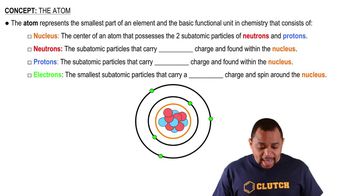
Isotopes are variants of a particular chemical element that have the same number of protons but different numbers of neutrons. This results in different atomic masses for the isotopes. For example, carbon-12 and carbon-14 are isotopes of carbon, with 6 protons and 6 or 8 neutrons, respectively. The notation for isotopes typically includes the mass number (total protons and neutrons) and the element symbol.
추천 영상:

Atomic Number

The atomic number of an element is the number of protons found in the nucleus of an atom, which uniquely identifies the element. It is denoted by the subscript in isotope notation. For carbon, the atomic number is 6, meaning all carbon atoms have 6 protons. When writing isotope symbols, the atomic number can be omitted if the element is clear from the context, as each element has a unique atomic number.
추천 영상:

Nuclear Notation

Nuclear notation is a shorthand way of representing isotopes, where the mass number is written as a superscript and the atomic number as a subscript next to the element symbol. For example, ¹³C represents carbon with a mass number of 13. Omitting the atomic number in this notation is permissible because the element symbol inherently conveys the atomic number, allowing for a more concise representation without losing clarity.
추천 영상:
가이드 코스
02:50
Standard Notation to Scientific Notation