Ch.2 - Atoms, Molecules & Ions
McMurry - Chemistry 8th Edition
McMurry8th EditionChemistryISBN: 9781292336145당신이 사용하는 게 아니라요?교과서 변경
2장, 문제 139

What is the identity of the element X in the following ions? (a) X2+, a cation that has 36 electrons (b) X-, an anion that has 36 electrons

검증된 단계별 안내
1
insert step 1> Determine the atomic number of element X in the cation X^{2+}. Since the cation has 36 electrons, the neutral atom must have 38 electrons (36 + 2).
insert step 2> Identify the element with atomic number 38 on the periodic table. This will give you the identity of element X in the cation X^{2+}.
insert step 3> Determine the atomic number of element X in the anion X^{-}. Since the anion has 36 electrons, the neutral atom must have 35 electrons (36 - 1).
insert step 4> Identify the element with atomic number 35 on the periodic table. This will give you the identity of element X in the anion X^{-}.
insert step 5> Compare the elements identified in steps 2 and 4 to confirm the identity of element X in both the cation and anion forms.

비슷한 문제에 대한 검증된 영상 답변:

이 영상 해법은 위 문제에 도움이 된다고 튜터들이 추천한 것입니다.
영상 길이:
1m

주요 개념

질문에 올바르게 답하기 위해 반드시 이해해야 하는 핵심 개념들은 다음과 같습니다.

Atomic Number and Electrons

The atomic number of an element is defined as the number of protons in its nucleus, which also equals the number of electrons in a neutral atom. In this question, the identity of element X can be determined by analyzing the number of electrons in its ionic forms. For X2+, having 36 electrons indicates it originally had 38 protons, while X-, with 36 electrons, suggests it originally had 35 protons.
추천 영상:
가이드 코스
00:46
Number of Electrons in Shells

Ionic Charge

Ionic charge refers to the electrical charge that an atom or molecule carries due to the loss or gain of electrons. A cation, like X2+, has a positive charge due to the loss of electrons, while an anion, like X-, has a negative charge due to the gain of electrons. Understanding how these charges relate to the number of electrons helps in identifying the element's identity based on its ionic forms.
추천 영상:

Periodic Table and Element Identity

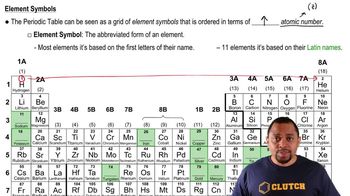
The periodic table organizes elements based on their atomic number and properties. Each element has a unique atomic number that corresponds to its identity. In this case, the element with an atomic number of 36 is krypton (Kr), which can be confirmed by recognizing that X2+ and X- correspond to the same element with different electron configurations, leading to the conclusion that X is krypton.
추천 영상:
가이드 코스
04:01
Periodic Table History