Ch.20 - Nuclear Chemistry
McMurry - Chemistry 8th Edition
McMurry8th EditionChemistryISBN: 9781292336145당신이 사용하는 게 아니라요?교과서 변경
20장, 문제 11

A sample 99mTc used for a whole body bone scan has an activity of 600 MBq. If the half-life is 6.01 hours, what mass of 99mTc was injected? (a) 3.1 ng (b) 8.4 microgram (c) 67 microgram (d) 2.7 mg

검증된 단계별 안내
1
Step 1: Understand the relationship between activity, decay constant, and number of atoms. The activity (A) of a radioactive sample is related to the number of radioactive atoms (N) and the decay constant (λ) by the equation A = λN.
Step 2: Calculate the decay constant (λ) using the half-life (t_{1/2}). The decay constant is given by the formula λ = \(\frac{0.693}{t_{1/2}\)}, where t_{1/2} is the half-life of the isotope.
Step 3: Rearrange the activity equation to solve for the number of atoms (N). Use the equation N = \(\frac{A}{λ}\), where A is the activity of the sample.
Step 4: Convert the number of atoms (N) to moles. Use Avogadro's number (6.022 \(\times\) 10^{23} atoms/mol) to convert the number of atoms to moles.
Step 5: Calculate the mass of 99mTc. Use the molar mass of 99mTc (approximately 99 g/mol) to convert the moles of 99mTc to mass.

주요 개념

질문에 올바르게 답하기 위해 반드시 이해해야 하는 핵심 개념들은 다음과 같습니다.

Radioactive Decay and Half-Life

Radioactive decay is the process by which an unstable atomic nucleus loses energy by emitting radiation. The half-life is the time required for half of the radioactive atoms in a sample to decay. Understanding half-life is crucial for calculating the remaining activity of a radioactive substance over time, which is essential in determining the initial amount of a radioactive isotope based on its current activity.
추천 영상:
가이드 코스
01:49
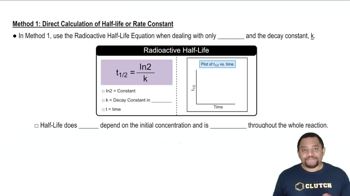
Method 1 of Radioactive Half-Life

Activity and Its Units

Activity refers to the rate at which a sample of radioactive material decays, measured in becquerels (Bq) or megabecquerels (MBq). One megabecquerel equals one million disintegrations per second. In this question, the activity of 600 MBq indicates how many disintegrations are occurring, which can be used alongside the half-life to calculate the initial mass of the radioactive isotope present.
추천 영상:
가이드 코스
02:02
Activity Series Chart

Mass-Energy Relationship in Radioactive Isotopes

The mass of a radioactive isotope can be calculated using its activity and half-life, applying the relationship between the number of radioactive atoms, their decay rate, and the isotope's molar mass. By using the decay constant derived from the half-life, one can determine the number of atoms present and subsequently convert this to mass using the molar mass of the isotope, which is essential for solving the problem.
추천 영상:
가이드 코스
04:12
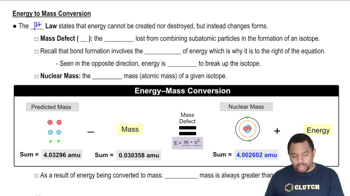
Energy to Mass Conversion
관련 실천
교과서 질문

Write balanced nuclear equations for the following processes.

(d) Positron emission of 165Ta

111
views

교과서 질문
Calculate the binding energy a uranium-235 nucleus in units of MeV/nucleon. The mass of an 235U atom is 235.043 929, the mass of a proton is 1.007 28, the mass of a neutron is 1.008 67, and the mass of an electron is 5.486 x 10^-4. (1 MeV = 1.60 x 10^-13 J) (a) 2.84 MeV/nucleon (b) 1.70 x 10^3 MeV/nucleon (c) 11.3 MeV/nucleon (d) 7.62 MeV/nucleon
2463
views
교과서 질문
Identify the true statement about nuclear power plants and nuclear weapons. (a) Nuclear power plants and nuclear weapons both use uranium enriched to about 90% U-235. (b) Nuclear power plants emit large amounts of CO2 just like coal burning power plants. (c) The United States produces less than 1% of its electrical power from nuclear energy. (d) A nuclear weapon explodes when two pieces of fission-able uranium-235 are pushed together to reach a critical mass.
396
views
교과서 질문

Complete and balance the following nuclear equations.

(d) <ISOTOPE CHEM REACTION>

121
views
교과서 질문
How much energy in kJ/mol is released by the fission of uranium-235 to form barium-140 and krypton-93? The atomic masses are (a) 6.59 x 10^9 kJ/mol (b) 1.66 x 10^10 kJ/mol (c) 1.98 x 10^11 kJ/mol (d) 1.66 x 10^16 kJ/mol
559
views
교과서 질문
Isotope A decays to isotope E through the following series of steps, in which the products of the individual decay events are themselves radioactive and undergo further decay until a stable nucleus is ultimately reached. Two kinds of processes are represented, one by the shorter arrows pointing right and the other by the longer arrows pointing left. (b) Identify and write the symbol for each isotope in the series:

423
views