
Ch.20 - Nuclear Chemistry
McMurry - Chemistry 8th Edition
McMurry8th EditionChemistryISBN: 9781292336145당신이 사용하는 게 아니라요?교과서 변경
20장, 문제 60

Radioactive decay exhibits a first-order rate law, rate = -∆N/∆t = kN, where N denotes the number of radio-active nuclei present at time t. The half-life of strontium-90, a dangerous nuclear fission product, is 29 years. (a) What fraction of the strontium-90 remains after three half-lives?

검증된 단계별 안내
1
Understand the concept of half-life: The half-life of a radioactive substance is the time it takes for half of the radioactive nuclei to decay.
Identify the number of half-lives passed: In this problem, three half-lives have passed for strontium-90.
Calculate the fraction remaining after each half-life: After one half-life, half of the original amount remains, which is \(\frac{1}{2}\) of the original amount.
Apply the half-life decay successively for each half-life: After the second half-life, half of the remaining amount from the first half-life will decay, leaving \(\frac{1}{2} \times \frac{1}{2} = \frac{1}{4}\) of the original amount.
Calculate the fraction remaining after the third half-life: Similarly, after the third half-life, half of the remaining amount from the second half-life will decay, leaving \(\frac{1}{4} \times \frac{1}{2} = \frac{1}{8}\) of the original amount.

비슷한 문제에 대한 검증된 영상 답변:

이 영상 해법은 위 문제에 도움이 된다고 튜터들이 추천한 것입니다.
영상 길이:
1m
도움이 되었나요?

주요 개념

질문에 올바르게 답하기 위해 반드시 이해해야 하는 핵심 개념들은 다음과 같습니다.

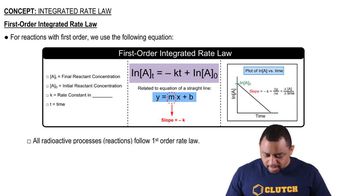
First-Order Kinetics

First-order kinetics refers to a reaction rate that is directly proportional to the concentration of one reactant. In the context of radioactive decay, this means that the rate at which a radioactive substance decays is dependent on the number of undecayed nuclei present. The mathematical representation, rate = -∆N/∆t = kN, indicates that as the number of nuclei decreases, the rate of decay also decreases.
추천 영상:
가이드 코스
02:29
First-Order Reactions

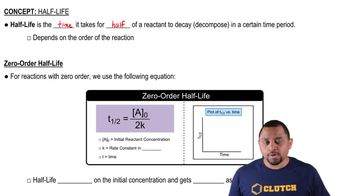
Half-Life

The half-life of a radioactive substance is the time required for half of the radioactive nuclei in a sample to decay. This concept is crucial for understanding the decay process, as it provides a consistent measure of how quickly a substance will lose its radioactivity. For strontium-90, with a half-life of 29 years, after each half-life, the remaining quantity of the substance is halved.
추천 영상:
가이드 코스
02:17
Zero-Order Half-life

Exponential Decay

Exponential decay describes the process by which a quantity decreases at a rate proportional to its current value. In radioactive decay, this means that after each half-life, the amount of the substance remaining can be calculated using the formula N(t) = N0 * (1/2)^(t/T), where N0 is the initial quantity, t is the elapsed time, and T is the half-life. This concept helps in determining the fraction of strontium-90 remaining after multiple half-lives.
추천 영상: