The decay constant of plutonium-239, a waste product from nuclear reactors, is 2.88 * 10-5 year - 1. What is the half-life of 239Pu?
검증된 단계별 안내
1
Identify the decay constant (λ) given in the problem. For plutonium-239, λ is 2.88 * 10^-5 year^-1.
Recall the relationship between the decay constant (λ) and the half-life (T_1/2) of a radioactive isotope, which is given by the formula: T_1/2 = ln(2) / λ.
Substitute the value of λ into the formula. Use the natural logarithm of 2 (ln(2)) which is approximately 0.693.
Perform the division to solve for T_1/2.
Express the half-life in appropriate units, which in this case would be years, to match the units of the decay constant.
비슷한 문제에 대한 검증된 영상 답변:
이 영상 해법은 위 문제에 도움이 된다고 튜터들이 추천한 것입니다.
영상 길이:
1m
영상 재생:
0 댓글
주요 개념
질문에 올바르게 답하기 위해 반드시 이해해야 하는 핵심 개념들은 다음과 같습니다.
Decay Constant
The decay constant (λ) is a probability rate at which a radioactive isotope decays. It is specific to each isotope and is expressed in units of time inverse, such as year⁻¹. A higher decay constant indicates a faster rate of decay, while a lower value suggests a slower decay process.
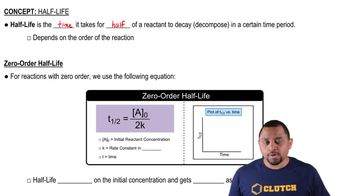
Half-life is the time required for half of the radioactive nuclei in a sample to decay. It is a crucial concept in nuclear chemistry, as it provides insight into the stability and longevity of radioactive materials. The half-life can be calculated using the decay constant with the formula t₁/₂ = ln(2)/λ.
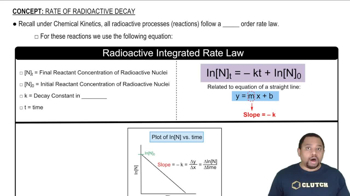
Radioactive decay is the process by which unstable atomic nuclei lose energy by emitting radiation. This process can result in the transformation of one element into another and occurs at a predictable rate characterized by the decay constant. Understanding this process is essential for calculating the remaining quantity of a radioactive substance over time.


 검증된 단계별 안내
 03:01
03:01