Ch.20 - Nuclear Chemistry
McMurry - Chemistry 8th Edition
McMurry8th EditionChemistryISBN: 9781292336145당신이 사용하는 게 아니라요?교과서 변경
20장, 문제 86

Thorium-232 decays by a 10-step series of nuclear reactions, ultimately yielding lead-208, along with 6 α particles and 4 β particles. How much energy (in kJ/mol) is released during the overall process? The relevant masses are 232Th = 232.038 054, 208Pb = 207.976 627, electron = 0.000 548 6, and 4He = 4.002 603.

검증된 단계별 안내
1
Step 1: Identify the nuclear reaction process. Thorium-232 decays to lead-208 through a series of nuclear reactions, emitting 6 alpha particles and 4 beta particles.
Step 2: Calculate the total mass of the reactants. The initial mass is the mass of Thorium-232, which is 232.038 054 u.
Step 3: Calculate the total mass of the products. This includes the mass of lead-208, 6 alpha particles, and 4 beta particles. Use the given masses: 208Pb = 207.976 627 u, 4He = 4.002 603 u, and electron = 0.000 548 6 u.
Step 4: Determine the mass defect. Subtract the total mass of the products from the total mass of the reactants to find the mass defect, which represents the mass converted to energy.
Step 5: Use Einstein's equation, E=mc^2, to calculate the energy released. Convert the mass defect from atomic mass units to kilograms, and then calculate the energy in joules. Finally, convert the energy to kJ/mol by considering Avogadro's number.

주요 개념

질문에 올바르게 답하기 위해 반드시 이해해야 하는 핵심 개념들은 다음과 같습니다.

Nuclear Decay

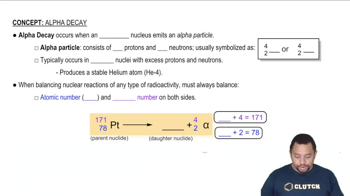
Nuclear decay is the process by which an unstable atomic nucleus loses energy by emitting radiation. This can occur through various types of decay, including alpha (α) decay, where helium nuclei are emitted, and beta (β) decay, where electrons or positrons are emitted. Understanding the types of decay is crucial for analyzing the transformation of thorium-232 into lead-208 and the associated particle emissions.
추천 영상:

Mass-Energy Equivalence

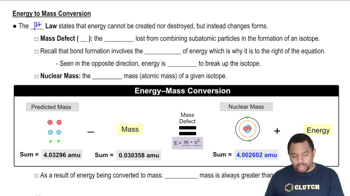
Mass-energy equivalence, expressed by Einstein's equation E=mc², states that mass can be converted into energy and vice versa. In nuclear reactions, the mass of the products is often less than the mass of the reactants, and this mass difference is converted into energy. Calculating the energy released during the decay of thorium-232 involves determining the mass defect and applying this principle to find the energy in kJ/mol.
추천 영상:
가이드 코스
04:12
Energy to Mass Conversion

Molar Mass and Energy Calculations

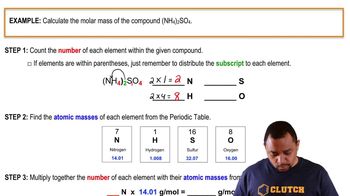
Molar mass is the mass of one mole of a substance, typically expressed in grams per mole. To calculate the energy released in kJ/mol during the decay process, one must first determine the total mass of the reactants and products, find the mass defect, and then convert this mass defect into energy using the mass-energy equivalence principle. This involves converting the energy from joules to kilojoules and adjusting for the number of moles involved in the reaction.
추천 영상:
가이드 코스
03:12
Molar Mass Calculation Example