Ch.20 - Nuclear Chemistry
McMurry - Chemistry 8th Edition
McMurry8th EditionChemistryISBN: 9781292336145당신이 사용하는 게 아니라요?교과서 변경
20장, 문제 87b

The radioactive isotope 100Tc decays to form the stable iso-tope 100Mo. (b) Only one of the pathways is observed. Calculate the energy released by both pathways, and explain why only one is observed. Relevant masses are: 100Tc = 99.907 657, 100Mo = 99.907 48, electron = 0.000 548 6.

검증된 단계별 안내
1
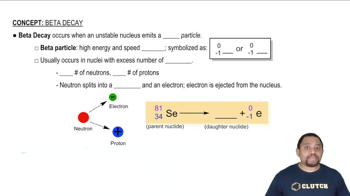
Identify the type of decay that 100Tc undergoes to form 100Mo. Since 100Tc decays to 100Mo, which has the same mass number but a different atomic number, this suggests a beta decay process.
Write the nuclear equations for the possible decay pathways. For beta-minus decay: \( ^{100}_{43}Tc \rightarrow ^{100}_{42}Mo + e^- + \bar{\nu}_e \). For beta-plus decay: \( ^{100}_{43}Tc \rightarrow ^{100}_{44}Ru + e^+ + \nu_e \).
Calculate the mass defect for each pathway. Mass defect is the difference between the mass of the parent nucleus and the sum of the masses of the products. For beta-minus decay: \( \Delta m = m(^{100}Tc) - (m(^{100}Mo) + m(e^-)) \). For beta-plus decay: \( \Delta m = m(^{100}Tc) - (m(^{100}Ru) + m(e^+)) \).
Convert the mass defect into energy released using Einstein's equation, E=mc^2, where E is the energy, m is the mass defect, and c is the speed of light. This will give the energy released for each decay pathway.
Analyze why only one pathway is observed. Consider factors such as the stability of the resulting nucleus, the energy threshold for positron emission, and conservation laws (like conservation of energy and lepton number) to explain why only one decay pathway is favored or observed.

비슷한 문제에 대한 검증된 영상 답변:

이 영상 해법은 위 문제에 도움이 된다고 튜터들이 추천한 것입니다.
영상 길이:
12m
도움이 되었나요?

주요 개념

질문에 올바르게 답하기 위해 반드시 이해해야 하는 핵심 개념들은 다음과 같습니다.

Radioactive Decay

Radioactive decay is a process by which an unstable atomic nucleus loses energy by emitting radiation. This can occur through various pathways, such as alpha decay, beta decay, or gamma decay. In the case of 100Tc, it decays to 100Mo, and understanding the type of decay involved is crucial for calculating the energy released.
추천 영상:
가이드 코스
03:00
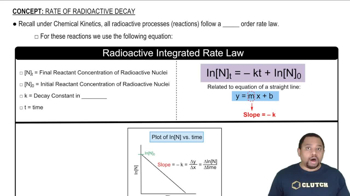
Rate of Radioactive Decay

Mass-Energy Equivalence

Mass-energy equivalence, expressed by Einstein's equation E=mc², indicates that mass can be converted into energy. In radioactive decay, the difference in mass between the parent isotope (100Tc) and the daughter isotope (100Mo) is converted into energy, which can be calculated to determine the energy released during the decay process.
추천 영상:
가이드 코스
04:12
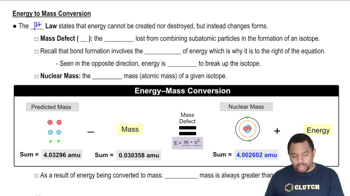
Energy to Mass Conversion

Pathways of Decay

Different pathways of decay refer to the various modes through which a radioactive isotope can transform into a more stable form. The observation of only one pathway suggests that it is the most energetically favorable or has a higher probability of occurring, often influenced by factors such as the energy barrier and the stability of the resulting isotopes.
추천 영상: