Ch.21 - Transition Elements and Coordination Chemistry
McMurry - Chemistry 8th Edition
McMurry8th EditionChemistryISBN: 9781292336145당신이 사용하는 게 아니라요?교과서 변경
21장, 문제 74

(a) Identify the Lewis acid and the Lewis base in the reaction of ethylenediamine (H2NCH2CH2NH2) with Ni2+ to form [Ni(en)3]2+.
(b) Identify the ligands and donor atoms.
(c) Give the coordination number and geometry of the metal in the complex.

검증된 단계별 안내
1
Identify the Lewis acid and Lewis base by determining which species donates an electron pair and which accepts it. In this reaction, the Ni2+ ion, which accepts electron pairs, is the Lewis acid, and ethylenediamine (H2NCH2CH2NH2), which donates electron pairs from its nitrogen atoms, is the Lewis base.
Determine the ligands in the complex. In this case, ethylenediamine acts as a ligand. Each ethylenediamine molecule has two nitrogen atoms that can donate electron pairs to the metal ion.
Identify the donor atoms within the ligands. For ethylenediamine, the donor atoms are the nitrogen atoms because they provide the lone pairs of electrons that coordinate with the metal ion.
Calculate the coordination number, which is the number of points at which ligands are attached to the metal ion. In [Ni(en)3]2+, each ethylenediamine provides two donor atoms, and there are three ethylenediamine ligands, leading to a total of six coordination sites being occupied.
Determine the geometry of the metal in the complex based on the coordination number. For a coordination number of six, the typical geometry is octahedral. Thus, the nickel ion in [Ni(en)3]2+ is surrounded octahedrally by the nitrogen atoms from the ethylenediamine ligands.

비슷한 문제에 대한 검증된 영상 답변:

이 영상 해법은 위 문제에 도움이 된다고 튜터들이 추천한 것입니다.

주요 개념

질문에 올바르게 답하기 위해 반드시 이해해야 하는 핵심 개념들은 다음과 같습니다.

Lewis Acids and Bases

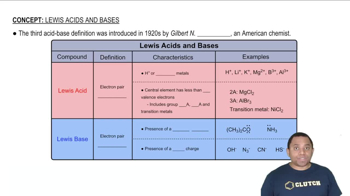
Lewis acids are species that can accept an electron pair, while Lewis bases are those that can donate an electron pair. In the given reaction, ethylenediamine acts as a Lewis base by donating its lone pair of electrons to the Ni2+ ion, which functions as a Lewis acid by accepting the electron pair to form a coordinate bond.
추천 영상:
가이드 코스
05:04
Lewis Acids and Bases

Coordination Complexes

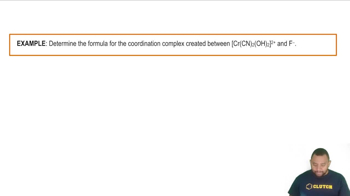
Coordination complexes consist of a central metal atom or ion bonded to surrounding molecules or ions called ligands. In this case, ethylenediamine serves as a bidentate ligand, meaning it can attach to the metal at two donor atoms, specifically the nitrogen atoms in its structure, forming a stable complex with Ni2+.
추천 영상:
가이드 코스
00:43
Coordination Complexes Example

Coordination Number and Geometry

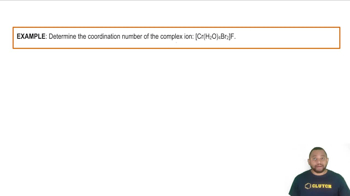
The coordination number refers to the number of ligand donor atoms that are bonded to the central metal ion. For the complex [Ni(en)3]2+, the coordination number is 6, as there are three bidentate ethylenediamine ligands. This arrangement typically results in an octahedral geometry around the nickel ion.
추천 영상:
가이드 코스
00:51
Coordination Numbers and Geometry Example