Ch.21 - Transition Elements and Coordination Chemistry
McMurry - Chemistry 8th Edition
McMurry8th EditionChemistryISBN: 9781292336145당신이 사용하는 게 아니라요?교과서 변경
21장, 문제 72b

Draw the structure of the following complexes. What are the oxidation state, coordination number, and coordination geometry of the metal in each?
(b) [Cr(NH3)2(C2O4)2]NO2

검증된 단계별 안내
1
Determine the oxidation state of Cr: Assume the oxidation state of Cr is x. Ammonia (NH3) is a neutral ligand, and oxalate (C2O4) is a bidentate ligand with a charge of -2. The complex is overall neutral, so x + 2(0) + 2(-2) = 0. Solve for x.
Identify the coordination number: Count the number of ligand donor atoms attached to the metal. Each NH3 contributes 1 donor atom, and each C2O4 contributes 2 donor atoms. Calculate the total.
Determine the coordination geometry: Based on the coordination number, predict the geometry. Common geometries include octahedral, tetrahedral, and square planar.
Draw the structure: Arrange the ligands around the metal center according to the determined geometry. Indicate the bidentate nature of the oxalate ligands.
Consider the counterion: Note that NO2 is the counterion and does not affect the coordination sphere of the complex.

비슷한 문제에 대한 검증된 영상 답변:

이 영상 해법은 위 문제에 도움이 된다고 튜터들이 추천한 것입니다.
도움이 되었나요?

주요 개념

질문에 올바르게 답하기 위해 반드시 이해해야 하는 핵심 개념들은 다음과 같습니다.

Oxidation State

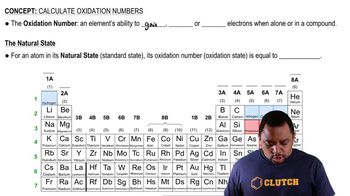
The oxidation state of an element in a compound indicates the degree of oxidation of that element, reflecting the number of electrons lost or gained. In coordination complexes, the oxidation state of the metal can be determined by considering the charges of the ligands and the overall charge of the complex. For example, in [Cr(NH3)2(C2O4)2]NO2, the oxidation state of chromium can be calculated based on the charges contributed by the ammonia and oxalate ligands.
추천 영상:
가이드 코스
02:42
Oxidation Numbers

Coordination Number

The coordination number refers to the total number of ligand atoms that are directly bonded to the central metal atom in a coordination complex. It is determined by the number of donor atoms from the ligands that coordinate to the metal. In the case of [Cr(NH3)2(C2O4)2], the coordination number can be assessed by counting the donor atoms from the two NH3 ligands and the two oxalate ligands.
추천 영상:
가이드 코스
00:27
Coordination Numbers

Coordination Geometry

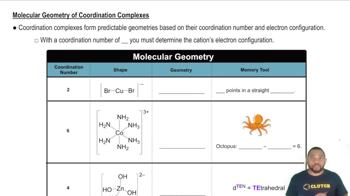
Coordination geometry describes the spatial arrangement of the ligands around the central metal atom in a coordination complex. Common geometries include octahedral, tetrahedral, and square planar, which depend on the coordination number and the steric and electronic properties of the ligands. For [Cr(NH3)2(C2O4)2], the coordination geometry can be inferred from the coordination number and the nature of the ligands involved.
추천 영상:
가이드 코스
02:40
Molecular Geometry of Coordination Complexes