Ch.21 - Transition Elements and Coordination Chemistry
McMurry - Chemistry 8th Edition
McMurry8th EditionChemistryISBN: 9781292336145당신이 사용하는 게 아니라요?교과서 변경
21장, 문제 21.116

Although Cl- is a weak-field ligand and CN- is a strong field ligand, [CrCl6]3- and [Cr(CN)6]3- exhibit approximately the same amount of paramagnetism. Explain.

검증된 단계별 안내
1
Identify the oxidation state of chromium in both complexes. Chromium is in the +3 oxidation state in both [CrCl_6]^{3-} and [Cr(CN)_6]^{3-}.
Determine the electron configuration of the Cr^{3+} ion. Chromium has an atomic number of 24, so its electron configuration is [Ar] 3d^5 4s^1. For Cr^{3+}, remove three electrons, resulting in [Ar] 3d^3.
Consider the effect of ligand field strength on the d-orbitals. Cl^- is a weak-field ligand, leading to a high-spin complex, while CN^- is a strong-field ligand, typically leading to a low-spin complex.
Analyze the number of unpaired electrons. In both complexes, the Cr^{3+} ion has three unpaired electrons in the 3d orbitals, resulting in similar paramagnetic properties.
Conclude that despite the difference in ligand field strength, the number of unpaired electrons remains the same in both complexes, explaining the similar paramagnetism.

비슷한 문제에 대한 검증된 영상 답변:

이 영상 해법은 위 문제에 도움이 된다고 튜터들이 추천한 것입니다.
도움이 되었나요?

주요 개념

질문에 올바르게 답하기 위해 반드시 이해해야 하는 핵심 개념들은 다음과 같습니다.

Ligand Field Theory

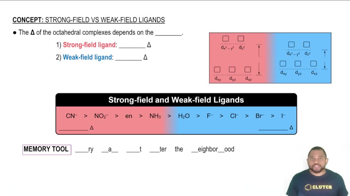
Ligand Field Theory explains how the presence of ligands around a central metal ion affects its electronic structure and the energy levels of its d-orbitals. Strong-field ligands, like CN<sup>-</sup>, cause a larger splitting of d-orbitals compared to weak-field ligands, like Cl<sup>-</sup>. This theory helps in understanding the magnetic properties of coordination complexes based on the arrangement and strength of the ligands.
추천 영상:
가이드 코스
02:40
Strong-Field Ligands result in a large Δ and Weak-Field Ligands result in a small Δ.

Paramagnetism

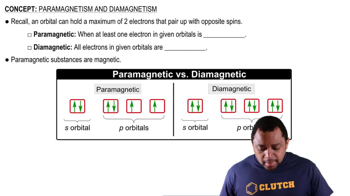
Paramagnetism is a form of magnetism that occurs in materials with unpaired electrons. In coordination complexes, the number of unpaired electrons determines the degree of paramagnetism. Both [CrCl<sub>6</sub>]<sup>3-</sup> and [Cr(CN)<sub>6</sub>]<sup>3-</sup> can exhibit similar levels of paramagnetism if they have the same number of unpaired electrons, despite the differences in ligand strength.
추천 영상:
가이드 코스
01:33
Paramagnetism and Diamagnetism

Crystal Field Splitting

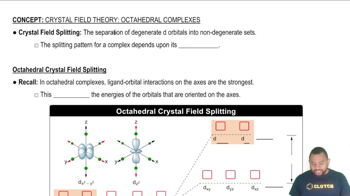
Crystal Field Splitting refers to the energy difference between the split d-orbitals in a transition metal complex due to the presence of ligands. In octahedral complexes, the d-orbitals split into two sets: t<sub>2g</sub> and e<sub>g</sub>. The extent of this splitting influences the electron configuration and, consequently, the magnetic properties of the complex, which can lead to similar paramagnetic behavior in complexes with different ligands.
추천 영상:
가이드 코스
03:04
The crystal field splitting pattern for octahedral complexes has the d orbitals on or along the axes as having the higher energy.