Ch.21 - Transition Elements and Coordination Chemistry
McMurry - Chemistry 8th Edition
McMurry8th EditionChemistryISBN: 9781292336145당신이 사용하는 게 아니라요?교과서 변경
21장, 문제 21.29

The oxalate ion is a bidentate ligand as indicated in Figure 21.8. Would you expect the carbonate ion to be a monodentate or bidentate ligand? Explain your reasoning.

검증된 단계별 안내
1
Step 1: Understand the terms. A ligand is a molecule or ion that binds to a central metal atom to form a coordination complex. Ligands can be monodentate (binds through one site) or bidentate (binds through two sites).
Step 2: Look at the structure of the carbonate ion (CO3^2-). It has three oxygen atoms, each with a lone pair of electrons. These lone pairs can potentially act as binding sites to a metal ion.
Step 3: However, due to the planar structure of the carbonate ion and the 120-degree angle between the oxygen atoms, it is not possible for more than one oxygen atom to simultaneously bind to a metal ion.
Step 4: Therefore, despite having three potential binding sites, the carbonate ion can only bind through one site at a time.
Step 5: Based on this reasoning, we would expect the carbonate ion to act as a monodentate ligand.

비슷한 문제에 대한 검증된 영상 답변:

이 영상 해법은 위 문제에 도움이 된다고 튜터들이 추천한 것입니다.
도움이 되었나요?

주요 개념

질문에 올바르게 답하기 위해 반드시 이해해야 하는 핵심 개념들은 다음과 같습니다.

Ligands

Ligands are ions or molecules that can donate a pair of electrons to a central metal atom to form a coordination complex. They can be classified based on the number of donor atoms they possess. Monodentate ligands have one donor atom, while bidentate ligands have two, allowing them to form multiple bonds with the metal center.
추천 영상:
가이드 코스
01:12
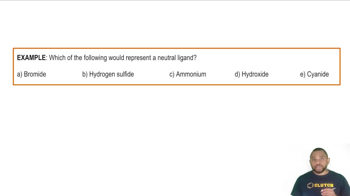
Ligands Example

Bidentate vs. Monodentate Ligands

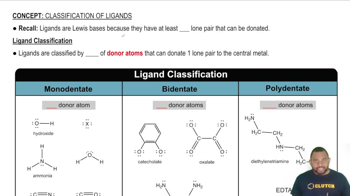
Bidentate ligands can attach to a metal ion at two separate sites, creating a more stable complex due to the chelation effect. In contrast, monodentate ligands bind through a single donor atom. The ability of a ligand to act as bidentate or monodentate depends on its structure and the presence of multiple donor atoms.
추천 영상:
가이드 코스
04:22
Ligand Classification

Structure of Carbonate Ion

The carbonate ion (CO3^2-) has a trigonal planar structure with three oxygen atoms surrounding a central carbon atom. Each oxygen atom can potentially act as a donor atom, but due to the geometry and bonding characteristics, carbonate typically acts as a monodentate ligand, binding through one oxygen atom at a time.
추천 영상:
가이드 코스
04:28
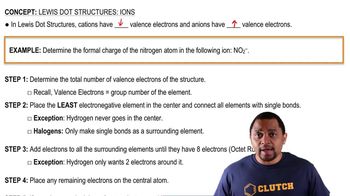
Lewis Dot Structures: Ions