
Ch.21 - Transition Elements and Coordination Chemistry
McMurry - Chemistry 8th Edition
McMurry8th EditionChemistryISBN: 9781292336145당신이 사용하는 게 아니라요?교과서 변경
21장, 문제 98

Consider the octahedral complex [Co(en)(dien)Cl]2+, where dien = H2NCH2CH2NHCH2CH2NH2, which can be abbreivated
(a) The dien (diethylenetriamine) ligand is a tridentate ligand. Explain what is meant by 'tridentate' and why dien can act as a tridentate ligand.
(b) Draw all possible stereoisomers of [Co(en)(dien)Cl]2+ (dien is a flexible ligand). Which stereoisomers are chiral, and which are achiral?

검증된 단계별 안내
1
**Step 1:** Understand the term 'tridentate'. A tridentate ligand is a ligand that can form three bonds to a central metal atom or ion. This is due to the presence of three donor atoms within the ligand that can each donate a pair of electrons to the metal center.
**Step 2:** Analyze the structure of dien (diethylenetriamine). Dien has three nitrogen atoms, each with a lone pair of electrons, which can coordinate to a metal center, making it a tridentate ligand.
**Step 3:** Consider the coordination environment in the complex [Co(en)(dien)Cl]^{2+}. The cobalt ion is in an octahedral coordination environment, which means it can form six bonds with ligands. Here, 'en' (ethylenediamine) is a bidentate ligand, 'dien' is tridentate, and there is one chloride ion.
**Step 4:** Draw the possible stereoisomers. In an octahedral complex with bidentate and tridentate ligands, different spatial arrangements can lead to stereoisomers. Consider the different ways the ligands can be arranged around the cobalt center.
**Step 5:** Determine chirality. A complex is chiral if it cannot be superimposed on its mirror image. Examine each stereoisomer to see if it has a plane of symmetry (achiral) or lacks one (chiral).

비슷한 문제에 대한 검증된 영상 답변:

이 영상 해법은 위 문제에 도움이 된다고 튜터들이 추천한 것입니다.
도움이 되었나요?

주요 개념

질문에 올바르게 답하기 위해 반드시 이해해야 하는 핵심 개념들은 다음과 같습니다.

Tridentate Ligands

A tridentate ligand is a type of chelating agent that can form three bonds to a central metal atom or ion. In the case of diethylenetriamine (dien), it has three nitrogen atoms that can coordinate with the metal center, allowing it to effectively 'wrap around' the metal and stabilize the complex. This multi-point attachment enhances the stability of the metal-ligand complex compared to monodentate ligands, which bind through only one atom.
추천 영상:
가이드 코스
01:12
Ligands Example

Stereoisomerism

Stereoisomerism refers to the phenomenon where compounds have the same molecular formula and connectivity of atoms but differ in the spatial arrangement of those atoms. In octahedral complexes like [Co(en)(dien)Cl]2+, the arrangement of ligands around the central metal can lead to different stereoisomers, including geometric isomers (cis/trans) and optical isomers (enantiomers), which are crucial for understanding the properties and reactivity of the complex.
추천 영상:

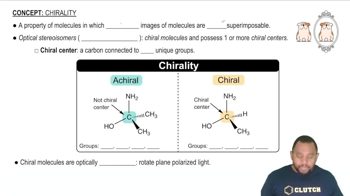
Chirality

Chirality is a property of a molecule that makes it non-superimposable on its mirror image, much like left and right hands. In coordination complexes, chirality arises when the arrangement of ligands creates an asymmetric environment around the metal center. Chiral stereoisomers can exhibit different optical activities, which is important in fields like pharmacology, where the activity of enantiomers can differ significantly.
추천 영상: