Ch.21 - Transition Elements and Coordination Chemistry
McMurry - Chemistry 8th Edition
McMurry8th EditionChemistryISBN: 9781292336145당신이 사용하는 게 아니라요?교과서 변경
21장, 문제 97

Tris(2-aminoethyl)amine, abbreviated tren, is the tetradentate ligand N(CH2CH2NH2)3. Using to represent each of the three NCH2CH2NH2 segments of the ligand, sketch all possible isomers of the octahedral complex [Co(tren)BrCl]+.

검증된 단계별 안내
1
Identify the coordination number and geometry of the complex. The complex [Co(tren)BrCl]+ has a coordination number of 6, forming an octahedral geometry.
Recognize that the ligand tren is tetradentate, meaning it occupies four coordination sites on the cobalt ion, leaving two sites for the halide ions (Br and Cl).
Consider the possible arrangements of the Br and Cl ligands in the octahedral complex. Since tren occupies four positions, Br and Cl can occupy the remaining two positions.
Determine the possible isomers. In an octahedral complex, the two halide ions can be either adjacent to each other (cis) or opposite each other (trans).
Sketch the isomers: one with Br and Cl in the cis position and another with Br and Cl in the trans position, keeping the tren ligand in a fixed position.

비슷한 문제에 대한 검증된 영상 답변:

이 영상 해법은 위 문제에 도움이 된다고 튜터들이 추천한 것입니다.

주요 개념

질문에 올바르게 답하기 위해 반드시 이해해야 하는 핵심 개념들은 다음과 같습니다.

Tetradentate Ligands

Tetradentate ligands are molecules that can form four bonds with a central metal ion. In the case of tren, it has three amine groups that can coordinate to a metal, allowing it to effectively bind and stabilize the metal ion in a complex. Understanding how these ligands interact with metal ions is crucial for predicting the geometry and properties of the resulting complexes.
추천 영상:
가이드 코스
01:12
Ligands Example

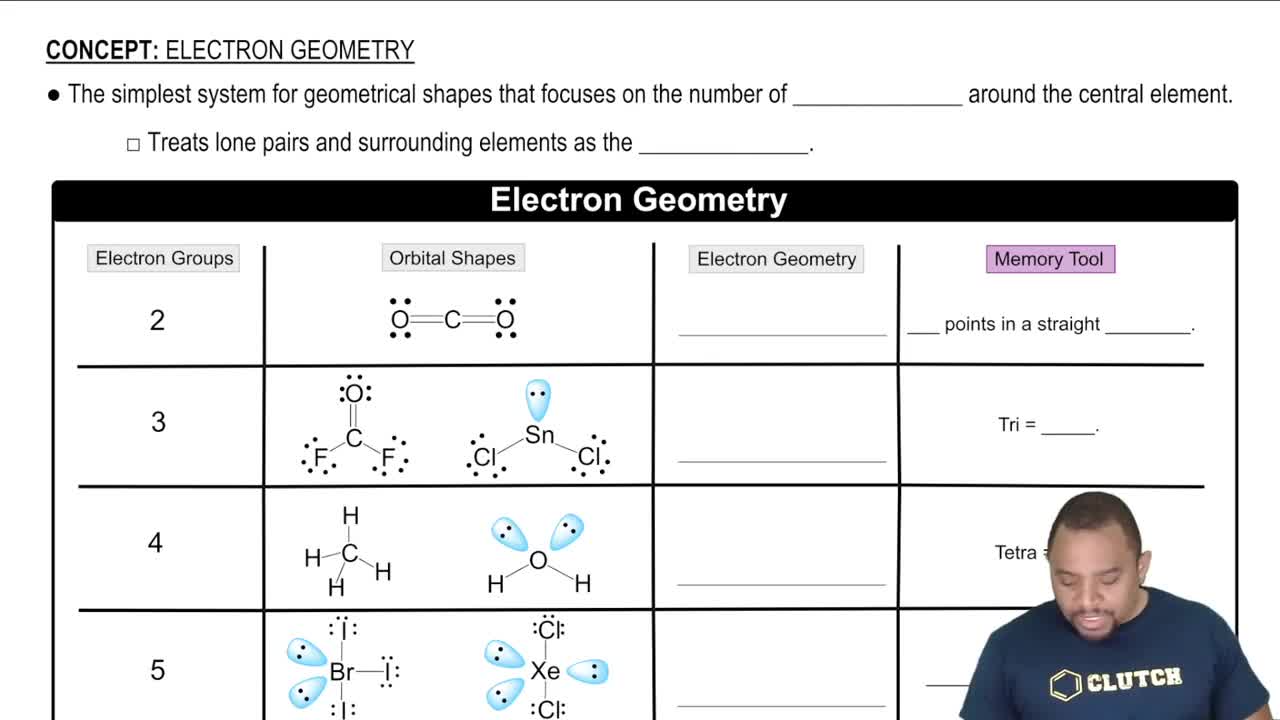
Octahedral Geometry

Octahedral geometry is a common arrangement of six ligands around a central metal ion, forming an octahedron. This geometry is typical for transition metal complexes, where the ligands occupy the vertices of the octahedron. Recognizing the spatial arrangement of ligands in octahedral complexes is essential for visualizing isomerism and understanding the complex's properties.
추천 영상:
가이드 코스
04:44
Electron Geometry

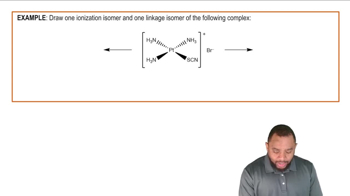
Isomerism in Coordination Compounds

Isomerism in coordination compounds refers to the existence of different compounds that have the same formula but different arrangements of atoms or ligands. In octahedral complexes, isomers can arise from variations in ligand positioning, such as facial (fac) and meridional (mer) isomers. Identifying and sketching these isomers requires a clear understanding of how ligands can be arranged around the central metal ion.
추천 영상:
가이드 코스
2:14
Isomerism in Coordination Complexes Example