Ch.21 - Transition Elements and Coordination Chemistry
McMurry - Chemistry 8th Edition
McMurry8th EditionChemistryISBN: 9781292336145당신이 사용하는 게 아니라요?교과서 변경
21장, 문제 55

The highest oxidation state for the early transition metals Sc, Ti, V, Cr, and Mn is the periodic group number. The highest oxidation state for the later transition elements Fe, Co, and Ni is less than the periodic group number. Explain.

검증된 단계별 안내
1
The oxidation state of an element is determined by the number of electrons it can lose, gain, or share when forming chemical compounds. For transition metals, this is often related to the number of d-electrons available for bonding.
Early transition metals like Scandium (Sc), Titanium (Ti), Vanadium (V), Chromium (Cr), and Manganese (Mn) have fewer d-electrons and are located in the first half of the transition metal series. They can achieve their highest oxidation states by using all their valence electrons, including s and d electrons, which corresponds to their group number.
For example, Manganese (Mn) is in group 7 and can exhibit an oxidation state of +7, as seen in permanganate ion (MnO4^-).
Later transition metals like Iron (Fe), Cobalt (Co), and Nickel (Ni) have more d-electrons and are located in the second half of the transition metal series. The d-electrons are more tightly bound and less available for bonding, resulting in lower maximum oxidation states than their group number.
For instance, Iron (Fe) is in group 8 but typically exhibits a maximum oxidation state of +6, as seen in ferrate ion (FeO4^2-), which is less than its group number. This is due to the increased stability of lower oxidation states and the involvement of d-electrons in bonding.

비슷한 문제에 대한 검증된 영상 답변:

이 영상 해법은 위 문제에 도움이 된다고 튜터들이 추천한 것입니다.
도움이 되었나요?

주요 개념

질문에 올바르게 답하기 위해 반드시 이해해야 하는 핵심 개념들은 다음과 같습니다.

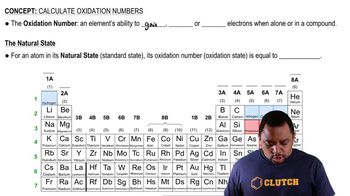
Oxidation States

Oxidation states indicate the degree of oxidation of an atom in a compound, reflecting the number of electrons lost or gained. For transition metals, these states can vary widely due to their ability to lose different numbers of d and s electrons. The highest oxidation state often corresponds to the group number in the periodic table, particularly for early transition metals, which can utilize all available valence electrons.
추천 영상:
가이드 코스
02:42
Oxidation Numbers

Transition Metals

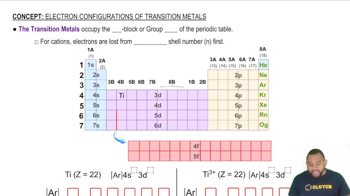
Transition metals are elements found in groups 3 to 12 of the periodic table, characterized by their ability to form variable oxidation states and complex ions. Early transition metals, such as Sc, Ti, V, Cr, and Mn, can achieve higher oxidation states due to their electronic configuration, allowing them to lose more electrons. In contrast, later transition metals like Fe, Co, and Ni typically exhibit lower oxidation states due to increased stability in their electron configurations.
추천 영상:
가이드 코스
03:12
Transition Metals

Periodic Trends

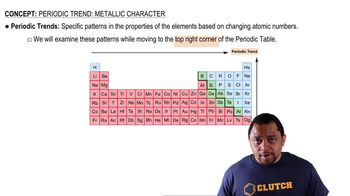
Periodic trends refer to the predictable patterns observed in the properties of elements as one moves across or down the periodic table. The group number often correlates with the maximum oxidation state for early transition metals, while later transition metals show a deviation from this trend. This is due to factors such as effective nuclear charge and electron shielding, which influence the ability of these metals to lose electrons and form higher oxidation states.
추천 영상:
가이드 코스
00:38
Periodic Trends