
Ch.21 - Transition Elements and Coordination Chemistry
McMurry - Chemistry 8th Edition
McMurry8th EditionChemistryISBN: 9781292336145당신이 사용하는 게 아니라요?교과서 변경
21장, 문제 52

Which of the following transition metals have more than one oxidation state?
(a) Ti
(b) V
(c) Cr
(d) Zn

검증된 단계별 안내
1
Identify the general property of transition metals: Transition metals are known for having multiple oxidation states due to the involvement of their d-orbitals in bonding.
Consider each element individually: (a) Titanium (Ti), (b) Vanadium (V), (c) Chromium (Cr), and (d) Zinc (Zn).
Recall that Titanium (Ti) commonly exhibits oxidation states of +2, +3, and +4.
Remember that Vanadium (V) can have oxidation states of +2, +3, +4, and +5.
Note that Chromium (Cr) typically shows oxidation states of +2, +3, and +6, while Zinc (Zn) usually only has an oxidation state of +2.

비슷한 문제에 대한 검증된 영상 답변:

이 영상 해법은 위 문제에 도움이 된다고 튜터들이 추천한 것입니다.
도움이 되었나요?

주요 개념

질문에 올바르게 답하기 위해 반드시 이해해야 하는 핵심 개념들은 다음과 같습니다.

Transition Metals

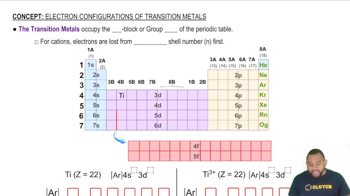
Transition metals are elements found in the d-block of the periodic table, characterized by their ability to form variable oxidation states. They typically have partially filled d-orbitals, which allow them to lose different numbers of electrons when forming compounds. This property is crucial for understanding their chemical behavior and reactivity.
추천 영상:
가이드 코스
03:12
Transition Metals

Oxidation States

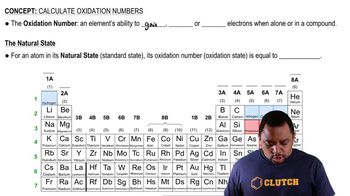
An oxidation state, or oxidation number, indicates the degree of oxidation of an atom in a compound. It reflects the number of electrons lost, gained, or shared when forming chemical bonds. Transition metals often exhibit multiple oxidation states due to their ability to lose different numbers of d and s electrons, which is essential for predicting their chemical reactions.
추천 영상:
가이드 코스
02:42
Oxidation Numbers

Common Oxidation States of Transition Metals

Different transition metals have characteristic oxidation states that they commonly exhibit. For example, titanium (Ti) can have oxidation states of +2, +3, and +4, while vanadium (V) can have +2, +3, +4, and +5. Understanding these common oxidation states helps in identifying which transition metals can participate in various chemical reactions and form different compounds.
추천 영상:
가이드 코스
03:12
Transition Metals