Ch.22 - The Main Group Elements
McMurry - Chemistry 8th Edition
McMurry8th EditionChemistryISBN: 9781292336145당신이 사용하는 게 아니라요?교과서 변경
22장, 문제 22.60

Compare some of the physical properties of H2S, NaH, and PdHx.

검증된 단계별 안내
1
Step 1: Start by identifying the type of bonding in each compound. H2S is a covalent compound, NaH is an ionic compound, and PdHx is a metallic compound.
Step 2: Consider the physical properties that are typically associated with each type of bonding. Covalent compounds like H2S usually have low melting and boiling points, are poor conductors of electricity, and are often gases or liquids at room temperature. Ionic compounds like NaH usually have high melting and boiling points, are good conductors of electricity when dissolved in water or melted, and are often solids at room temperature. Metallic compounds like PdHx usually have variable melting and boiling points, are good conductors of electricity and heat, and are often solids at room temperature.
Step 3: Consider the specific properties of each compound. For example, H2S is a gas at room temperature with a strong, unpleasant smell. NaH is a solid at room temperature that reacts violently with water. PdHx is a solid at room temperature that can absorb a large amount of hydrogen gas.
Step 4: Consider the effect of molecular structure on the properties of the compounds. For example, the bent shape of the H2S molecule due to its two lone pairs of electrons can affect its properties.
Step 5: Finally, compare the properties of the three compounds. For example, H2S and NaH are both poor conductors of electricity, but NaH has a much higher melting point. PdHx and NaH are both solids at room temperature, but PdHx is a much better conductor of electricity.

비슷한 문제에 대한 검증된 영상 답변:

이 영상 해법은 위 문제에 도움이 된다고 튜터들이 추천한 것입니다.
도움이 되었나요?

주요 개념

질문에 올바르게 답하기 위해 반드시 이해해야 하는 핵심 개념들은 다음과 같습니다.

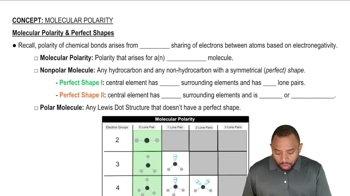
Molecular Structure and Polarity

The molecular structure of a compound determines its polarity, which affects its physical properties such as boiling point, solubility, and intermolecular interactions. For instance, H2S is a polar molecule due to its bent shape and the electronegativity difference between hydrogen and sulfur, leading to stronger dipole-dipole interactions compared to nonpolar molecules.
추천 영상:
가이드 코스
02:38
Molecular Polarity

Ionic vs. Covalent Compounds

Understanding the difference between ionic and covalent compounds is crucial for comparing physical properties. NaH is an ionic compound, which typically has high melting and boiling points due to strong electrostatic forces between ions, while H2S and PdHx are covalent, exhibiting lower melting and boiling points due to weaker van der Waals forces.
추천 영상:
가이드 코스
02:11
Ionic Compounds Naming

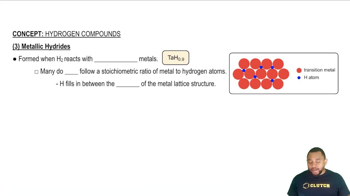
Metal-Hydride Properties

Metal hydrides, such as PdHx, exhibit unique properties due to the interaction between metal and hydrogen. These compounds can have varying stoichiometries and can influence the physical properties like density and thermal conductivity, which differ significantly from those of molecular compounds like H2S and ionic compounds like NaH.
추천 영상:
가이드 코스
01:00
Metallic Hydrides