Ch.22 - The Main Group Elements
McMurry - Chemistry 8th Edition
McMurry8th EditionChemistryISBN: 9781292336145당신이 사용하는 게 아니라요?교과서 변경
22장, 문제 20d

Look at the location of elements A, B, C, and D in the following periodic table:
(d) Which hydrides react with water to give an acidic solution, and which give a basic solution?

검증된 단계별 안내
1
insert step 1> Identify the elements A, B, C, and D on the periodic table and determine their group numbers.
insert step 2> Recall that hydrides of nonmetals (typically found on the right side of the periodic table) tend to form acidic solutions when they react with water.
insert step 3> Recall that hydrides of metals (typically found on the left side of the periodic table) tend to form basic solutions when they react with water.
insert step 4> Determine whether each element forms a metal hydride or a nonmetal hydride based on its position in the periodic table.
insert step 5> Classify the hydrides of elements A, B, C, and D as either forming acidic or basic solutions when reacting with water based on their classification as metal or nonmetal hydrides.

비슷한 문제에 대한 검증된 영상 답변:

이 영상 해법은 위 문제에 도움이 된다고 튜터들이 추천한 것입니다.
도움이 되었나요?

주요 개념

질문에 올바르게 답하기 위해 반드시 이해해야 하는 핵심 개념들은 다음과 같습니다.

Periodic Trends

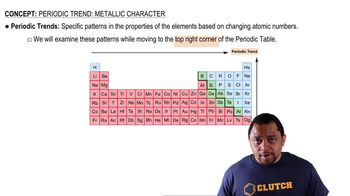
Periodic trends refer to the predictable patterns observed in the properties of elements as you move across or down the periodic table. These trends include atomic size, ionization energy, and electronegativity, which influence how elements interact with each other, including their reactivity with water.
추천 영상:
가이드 코스
00:38
Periodic Trends

Acid-Base Chemistry

Acid-base chemistry involves the study of substances that can donate protons (acids) or accept protons (bases). When hydrides react with water, they can produce acidic or basic solutions depending on their ability to release H+ ions or OH- ions, respectively, which is crucial for determining the nature of the solution formed.
추천 영상:
가이드 코스
02:00
Arrhenius Acids and Bases

Hydride Classification

Hydrides are compounds formed between hydrogen and other elements. They can be classified into ionic, covalent, and metallic hydrides, each exhibiting different properties. The classification helps predict their behavior in reactions with water, determining whether they will yield acidic or basic solutions.
추천 영상:
가이드 코스
04:22
Ligand Classification