Ch.22 - The Main Group Elements
McMurry - Chemistry 8th Edition
McMurry8th EditionChemistryISBN: 9781292336145당신이 사용하는 게 아니라요?교과서 변경
22장, 문제 22.160d

Give one example from main-group chemistry that illustrates each of the following descriptions.
d. Polar molecule that violates the octet rule

검증된 단계별 안내
1
1. The octet rule states that atoms tend to combine in such a way that they each have eight electrons in their valence shells, giving them the same electronic configuration as a noble gas. However, there are exceptions to this rule, and some molecules can have less than eight electrons (incomplete octet) or more than eight electrons (expanded octet) around the central atom.
2. A polar molecule is a molecule in which the bond dipoles do not cancel each other out, resulting in a net dipole moment. This happens when there is an uneven distribution of electron density, which is usually due to the presence of electronegative atoms or asymmetrical molecular structures.
3. An example of a polar molecule that violates the octet rule is Boron trifluoride (BF3).
4. In BF3, the boron atom only has six electrons in its valence shell, violating the octet rule. The molecule is planar and symmetrical, but the B-F bonds are polar because fluorine is more electronegative than boron. However, the dipole moments of the three B-F bonds cancel each other out, making the molecule nonpolar.
5. Therefore, it's important to note that while BF3 is an example of a molecule that violates the octet rule, it is not a polar molecule. A better example might be the ammonium ion (NH4+), which also violates the octet rule (since the nitrogen atom is surrounded by 10 electrons), but is a polar molecule due to its asymmetrical shape and the presence of polar N-H bonds.

비슷한 문제에 대한 검증된 영상 답변:

이 영상 해법은 위 문제에 도움이 된다고 튜터들이 추천한 것입니다.
도움이 되었나요?

주요 개념

질문에 올바르게 답하기 위해 반드시 이해해야 하는 핵심 개념들은 다음과 같습니다.

Polar Molecules

Polar molecules are molecules that have a net dipole moment due to the presence of polar bonds, which arise from differences in electronegativity between atoms. This results in an uneven distribution of electron density, leading to partial positive and negative charges. A common example is water (H2O), where the oxygen atom is more electronegative than hydrogen, creating a polar structure.
추천 영상:
가이드 코스
02:38
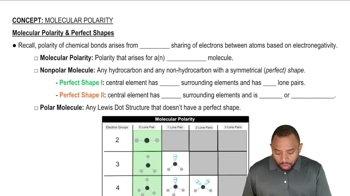
Molecular Polarity

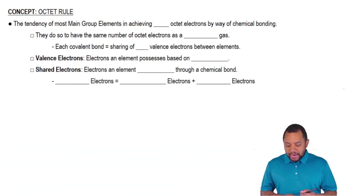
Octet Rule

The octet rule is a chemical guideline that states atoms tend to bond in such a way that they each have eight electrons in their valence shell, achieving a stable electron configuration similar to that of noble gases. However, some molecules, particularly those involving elements from the third period and beyond, can violate this rule by having more or fewer than eight electrons, as seen in molecules like phosphorus trifluoride (PF3).
추천 영상:

Examples of Molecules Violating the Octet Rule

Certain molecules, such as sulfur dioxide (SO2) and phosphorus pentachloride (PCl5), illustrate violations of the octet rule. In SO2, the sulfur atom has only six valence electrons in its bonding structure, while in PCl5, phosphorus can expand its valence shell to accommodate more than eight electrons. These examples highlight how some elements can exceed the octet rule due to their ability to utilize d-orbitals.
추천 영상: