
Ch.22 - The Main Group Elements
McMurry - Chemistry 8th Edition
McMurry8th EditionChemistryISBN: 9781292336145당신이 사용하는 게 아니라요?교과서 변경
22장, 문제 22.44e

Consider the elements C, Se, B, Sn, and Cl. Identify which of these elements:
e. Forms a hydride with the empirical formula 

검증된 단계별 안내
1
Identify the group and period of each element: C (Carbon), Se (Selenium), B (Boron), Sn (Tin), and Cl (Chlorine).
Recall that hydrides are compounds formed between hydrogen and another element, often from groups 1, 2, 13-17 of the periodic table.
Consider the typical hydride formulas for each group: Group 14 elements like C and Sn form hydrides with the formula MH4, Group 15 elements form MH3, Group 16 elements like Se form MH2, and Group 17 elements like Cl form MH.
Determine which of these elements typically forms a hydride with the empirical formula given in the problem.
Conclude which element from the list forms a hydride with the empirical formula that matches the typical hydride formula for its group.

비슷한 문제에 대한 검증된 영상 답변:

이 영상 해법은 위 문제에 도움이 된다고 튜터들이 추천한 것입니다.
도움이 되었나요?

주요 개념

질문에 올바르게 답하기 위해 반드시 이해해야 하는 핵심 개념들은 다음과 같습니다.

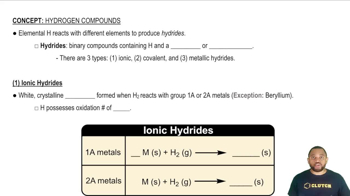
Hydrides

Hydrides are compounds formed between hydrogen and another element. They can be classified into ionic, covalent, and metallic hydrides, depending on the nature of the bond. Understanding the type of hydride formed is essential for predicting the properties and reactivity of the compound.
추천 영상:

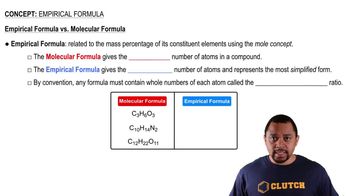
Empirical Formula

An empirical formula represents the simplest whole-number ratio of atoms in a compound. It provides essential information about the composition of the compound without detailing the actual number of atoms or the structure. This concept is crucial for identifying the correct hydride formed by the elements listed.
추천 영상:
가이드 코스
02:26
Empirical vs Molecular Formula

Element Properties

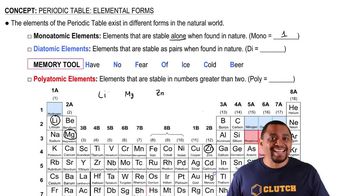
The properties of elements, such as electronegativity, atomic size, and bonding behavior, influence their ability to form hydrides. For instance, nonmetals like carbon and chlorine typically form covalent hydrides, while metals like tin can form ionic hydrides. Recognizing these properties helps in predicting which elements can form hydrides with hydrogen.
추천 영상:
가이드 코스
02:35
Elemental Forms of Elements