
Ch.22 - The Main Group Elements
McMurry - Chemistry 8th Edition
McMurry8th EditionChemistryISBN: 9781292336145당신이 사용하는 게 아니라요?교과서 변경
22장, 문제 22.19f

Locate each of the following elements on the periodic table.
(f) Group 5A element that forms the strongest p bonds

검증된 단계별 안내
1
Identify the elements in Group 5A (also known as Group 15) of the periodic table. These elements include nitrogen (N), phosphorus (P), arsenic (As), antimony (Sb), and bismuth (Bi).
Understand that p bonds (pi bonds) are a type of covalent bond that results from the side-to-side overlap of p orbitals. Strong p bonds are typically formed by elements with smaller atomic radii and higher electronegativity.
Consider the electronegativity and atomic size of the Group 5A elements. Nitrogen, being the smallest and most electronegative element in this group, is likely to form the strongest p bonds.
Recall that nitrogen commonly forms multiple bonds, such as the triple bond in N₂, which includes one sigma bond and two pi bonds, demonstrating its ability to form strong p bonds.
Conclude that among the Group 5A elements, nitrogen is the element that forms the strongest p bonds due to its small size and high electronegativity.

비슷한 문제에 대한 검증된 영상 답변:

이 영상 해법은 위 문제에 도움이 된다고 튜터들이 추천한 것입니다.
도움이 되었나요?

주요 개념

질문에 올바르게 답하기 위해 반드시 이해해야 하는 핵심 개념들은 다음과 같습니다.

Periodic Table

The periodic table is a systematic arrangement of elements based on their atomic number, electron configuration, and recurring chemical properties. Elements are organized into rows (periods) and columns (groups), with similar properties found in the same group. Understanding the layout of the periodic table is essential for identifying elements and predicting their behavior in chemical reactions.
추천 영상:
가이드 코스
02:40
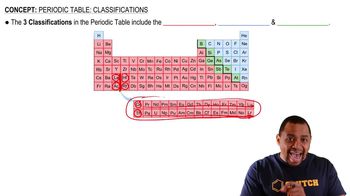
Periodic Table Classifications

Group 5A Elements

Group 5A, also known as Group 15, includes elements such as nitrogen (N), phosphorus (P), arsenic (As), antimony (Sb), and bismuth (Bi). These elements have five valence electrons and exhibit a range of oxidation states. They are known for their ability to form various types of bonds, including p bonds, which are crucial for understanding their chemical reactivity and bonding characteristics.
추천 영상:
가이드 코스
01:32
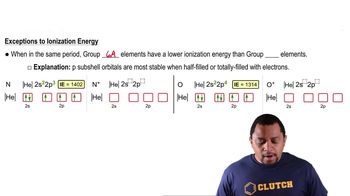
Group 6A vs. Group 5A Elements

P Bonds

P bonds, or pi bonds, are a type of covalent bond that occurs when two lobes of an orbital on one atom overlap with two lobes of an orbital on another atom, typically involving p orbitals. These bonds are generally formed in addition to sigma bonds and are essential in the formation of double and triple bonds. The strength and stability of p bonds influence the chemical properties of molecules, particularly in organic and coordination chemistry.
추천 영상: