Ch.22 - The Main Group Elements
McMurry - Chemistry 8th Edition
McMurry8th EditionChemistryISBN: 9781292336145당신이 사용하는 게 아니라요?교과서 변경
22장, 문제 22.23a

The following pictures represent structures of the hydrides of four second-row elements:
(1)
(2)
(3)
(4)
(a) Which compound has the highest melting point?

검증된 단계별 안내
1
Identify the second-row elements in the periodic table, which are lithium (Li), beryllium (Be), boron (B), carbon (C), nitrogen (N), oxygen (O), and fluorine (F).
Determine the hydrides of these elements: LiH, BeH2, BH3, CH4, NH3, H2O, and HF.
Consider the types of intermolecular forces present in each hydride: London dispersion forces, dipole-dipole interactions, and hydrogen bonding.
Recognize that hydrogen bonding is the strongest intermolecular force and occurs in NH3, H2O, and HF.
Compare the strength of hydrogen bonding in NH3, H2O, and HF, noting that HF typically has the strongest hydrogen bonds due to the high electronegativity of fluorine.

비슷한 문제에 대한 검증된 영상 답변:

이 영상 해법은 위 문제에 도움이 된다고 튜터들이 추천한 것입니다.
도움이 되었나요?

주요 개념

질문에 올바르게 답하기 위해 반드시 이해해야 하는 핵심 개념들은 다음과 같습니다.

Hydride Structures

Hydrides are compounds formed between hydrogen and other elements. The structure of a hydride can significantly influence its physical properties, including melting point. For second-row elements, the type of bonding (ionic, covalent, or metallic) and molecular geometry play crucial roles in determining the stability and melting point of the hydride.
추천 영상:
가이드 코스
01:00
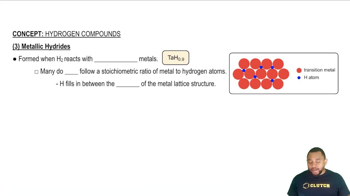
Metallic Hydrides

Melting Point Trends

The melting point of a compound is influenced by the strength of the intermolecular forces present. Generally, ionic compounds have higher melting points due to strong electrostatic forces, while covalent compounds may vary based on molecular size and polarity. Understanding these trends helps predict which hydride will have the highest melting point among the given options.
추천 영상:
가이드 코스
04:29
Boiling Point and Melting Point

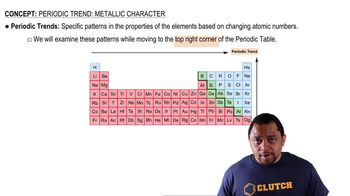
Periodic Trends

Periodic trends refer to the predictable patterns in the properties of elements as you move across or down the periodic table. For second-row elements, factors such as electronegativity, atomic size, and the type of bonding can affect the properties of their hydrides. Recognizing these trends is essential for comparing the melting points of different hydrides.
추천 영상:
가이드 코스
00:38
Periodic Trends