
Ch.22 - The Main Group Elements
McMurry - Chemistry 8th Edition
McMurry8th EditionChemistryISBN: 9781292336145당신이 사용하는 게 아니라요?교과서 변경
22장, 문제 32

Which element in each of the following pairs has the higher ionization energy? (a) As or Cl (b) Mg or Ba

검증된 단계별 안내
1
Step 1: Understand the concept of ionization energy. Ionization energy is the energy required to remove an electron from an atom in its gaseous state. It generally increases across a period and decreases down a group in the periodic table.
Step 2: Analyze the position of As and Cl in the periodic table. Arsenic (As) is in group 15 and period 4, while Chlorine (Cl) is in group 17 and period 3.
Step 3: Apply the periodic trend for ionization energy to As and Cl. Since Cl is to the right of As in the same period, Cl has a higher ionization energy than As.
Step 4: Analyze the position of Mg and Ba in the periodic table. Magnesium (Mg) is in group 2 and period 3, while Barium (Ba) is in group 2 and period 6.
Step 5: Apply the periodic trend for ionization energy to Mg and Ba. Since Mg is above Ba in the same group, Mg has a higher ionization energy than Ba.

주요 개념

질문에 올바르게 답하기 위해 반드시 이해해야 하는 핵심 개념들은 다음과 같습니다.

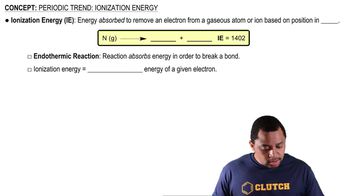
Ionization Energy

Ionization energy is the energy required to remove an electron from an atom in its gaseous state. It is a key factor in determining an element's reactivity and is influenced by the atomic size and the effective nuclear charge. Generally, ionization energy increases across a period from left to right and decreases down a group in the periodic table.
추천 영상:
가이드 코스
01:19
Ionization Energy

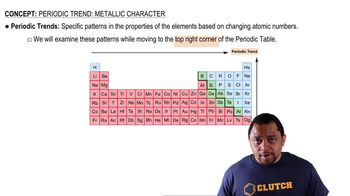
Periodic Trends

Periodic trends refer to the predictable patterns observed in the properties of elements as you move across periods or down groups in the periodic table. For ionization energy, elements on the right side of the table (like Cl) typically have higher ionization energies than those on the left (like As), while elements higher up in a group (like Mg) have higher ionization energies than those lower down (like Ba).
추천 영상:
가이드 코스
00:38
Periodic Trends

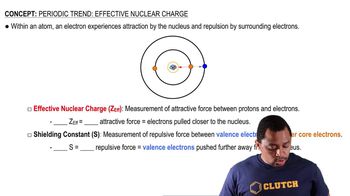
Effective Nuclear Charge

Effective nuclear charge (Z_eff) is the net positive charge experienced by an electron in a multi-electron atom. It accounts for the shielding effect of inner electrons that reduces the full nuclear charge. A higher effective nuclear charge leads to a stronger attraction between the nucleus and the outer electrons, resulting in higher ionization energy, particularly for elements with fewer electron shells.
추천 영상:
가이드 코스
01:51
Effective Nuclear Charge