Ch.22 - The Main Group Elements
McMurry - Chemistry 8th Edition
McMurry8th EditionChemistryISBN: 9781292336145당신이 사용하는 게 아니라요?교과서 변경
22장, 문제 33

Arrange the following elements in order of increasing ionization energy: (a) N (b) Ca (c) Rb (d) Se.

검증된 단계별 안내
1
Step 1: Understand the concept of ionization energy. Ionization energy is the energy required to remove an electron from an atom in its gaseous state. It generally increases across a period and decreases down a group in the periodic table.
Step 2: Identify the position of each element in the periodic table. Nitrogen (N) is in period 2, group 15; Calcium (Ca) is in period 4, group 2; Rubidium (Rb) is in period 5, group 1; and Selenium (Se) is in period 4, group 16.
Step 3: Apply the periodic trend for ionization energy. As you move from left to right across a period, ionization energy increases. As you move down a group, ionization energy decreases.
Step 4: Compare the elements based on their positions. Since N is to the right of Ca and Se in the same period, it has a higher ionization energy. Rb, being further down in group 1, has the lowest ionization energy.
Step 5: Arrange the elements in order of increasing ionization energy based on the trends: Rb < Ca < Se < N.

주요 개념

질문에 올바르게 답하기 위해 반드시 이해해야 하는 핵심 개념들은 다음과 같습니다.

Ionization Energy

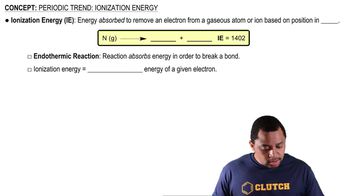
Ionization energy is the energy required to remove an electron from an atom or ion in its gaseous state. It is a key factor in determining an element's reactivity and is influenced by the atomic size and the effective nuclear charge. Generally, ionization energy increases across a period and decreases down a group in the periodic table.
추천 영상:
가이드 코스
01:19
Ionization Energy

Periodic Trends

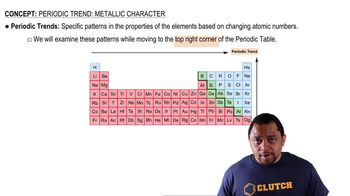
Periodic trends refer to the predictable patterns observed in the properties of elements as you move across or down the periodic table. For ionization energy, elements on the right side of the table (like nitrogen and selenium) typically have higher ionization energies than those on the left (like calcium and rubidium). Understanding these trends helps in predicting the order of ionization energies among different elements.
추천 영상:
가이드 코스
00:38
Periodic Trends

Group and Period Position

The position of an element in the periodic table, defined by its group (column) and period (row), significantly affects its ionization energy. Elements in Group 1 (alkali metals) like rubidium have low ionization energies, while nonmetals in Group 15 (like nitrogen) and Group 16 (like selenium) have higher ionization energies. This positioning helps in arranging elements based on their ionization energy.
추천 영상:
가이드 코스
01:33
Lone Pair Positions