Ch.22 - The Main Group Elements
McMurry - Chemistry 8th Edition
McMurry8th EditionChemistryISBN: 9781292336145당신이 사용하는 게 아니라요?교과서 변경
22장, 문제 34

Which element in each of the following pairs has the larger atomic radius? (a) Sn or P (b) Ge or Br

검증된 단계별 안내
1
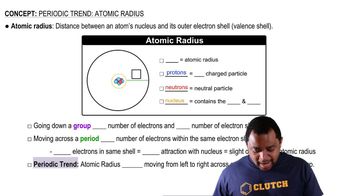
Step 1: Understand the concept of atomic radius. The atomic radius is the distance from the nucleus of an atom to the outermost electron shell. It generally increases as you move down a group in the periodic table and decreases as you move across a period from left to right.
Step 2: Analyze the position of Sn (tin) and P (phosphorus) in the periodic table. Sn is located in Group 14 and Period 5, while P is in Group 15 and Period 3. Since Sn is further down the group than P, it has more electron shells, leading to a larger atomic radius.
Step 3: Compare Ge (germanium) and Br (bromine) in the periodic table. Ge is in Group 14 and Period 4, while Br is in Group 17 and Period 4. Both elements are in the same period, but Ge is to the left of Br. Atomic radius decreases across a period, so Ge has a larger atomic radius than Br.
Step 4: Consider the effect of effective nuclear charge. As you move across a period, the effective nuclear charge increases, pulling electrons closer to the nucleus and reducing the atomic radius. This explains why elements on the left of a period generally have larger atomic radii than those on the right.
Step 5: Conclude that in each pair, the element that is either further down a group or further to the left in a period will have the larger atomic radius. Therefore, Sn has a larger atomic radius than P, and Ge has a larger atomic radius than Br.

주요 개념

질문에 올바르게 답하기 위해 반드시 이해해야 하는 핵심 개념들은 다음과 같습니다.

Atomic Radius

Atomic radius is a measure of the size of an atom, typically defined as the distance from the nucleus to the outermost electron shell. It varies across the periodic table, generally increasing down a group due to the addition of electron shells and decreasing across a period due to increased nuclear charge, which pulls electrons closer to the nucleus.
추천 영상:

Periodic Trends

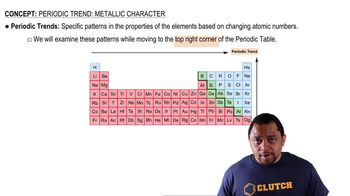
Periodic trends refer to the predictable patterns observed in the properties of elements as you move across or down the periodic table. Key trends include atomic radius, ionization energy, and electronegativity, which help in understanding how elements behave and interact with one another based on their position in the table.
추천 영상:
가이드 코스
00:38
Periodic Trends

Group and Period Relationships

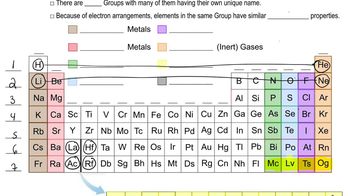
Elements are organized into groups (columns) and periods (rows) in the periodic table. Elements in the same group share similar properties and have the same number of valence electrons, while elements in the same period have the same number of electron shells. Understanding these relationships is crucial for predicting atomic size and other chemical properties.
추천 영상:
가이드 코스
05:33
Periodic Table: Group Names